← The Fife and Drum / November 2022 (Vol 2022, No 3)
↗ View this article in the original PDF newsletter
What is there to say that hasn’t already been said about the remarkable reign of Queen Elizabeth II or, as she is increasingly being called, Elizabeth the Faithful. One of Her Majesty’s great legacies will be that amongst all the extraordinary moments following her death, including the genuine outpouring of grief from across the Commonwealth, the Crown passed benignly to her son during a decade marked by considerable turmoil. The ease in which Charles III ascended the throne in this realm and across the Commonwealth was in no small part thanks to the high esteem and respect accorded to Her Majesty. What happens next rests on the shoulders of The King, a man well-suited and well-trained for what at times will be an unforgiving responsibility in our 21st century.
Many of us watched the funeral, attended by an impressive Canadian delegation headed by the Governor General, Prime Minister, and Indigenous leadership. Americans were quick to point out on social media that while only the President and First Lady were invited (and not seated prominently at Westminster Abbey), Canada’s invitees included former governors general, prime ministers and other prominent Canadians. It was a reminder that there are consequences for rebellion.
The procession of Her Majesty’s coffin from Westminster Abbey to the Wellington Arch was led, at her request, by members from the Royal Canadian Mounted Police. The Mounties were followed, amongst other members of the Commonwealth forces, by representatives of sixteen regiments of the Canadian Forces. For those present, both in-person and virtually, it was a day that will not soon be forgotten – one that truly turned a page on an age. Those poignant final moments during the committal service at St George’s Chapel were especially moving.
Throughout it all, there was something very comforting knowing that soon in the George VI Memorial Chapel, a quiet corner of St. George’s Chapel, “We Four” (the name George VI used for their close-knit family) would now be reunited. Of course, it was not “We Four + 1,” as The Queen’s beloved Philip, her strength and stay, was reinterred beside her after their brief time apart.
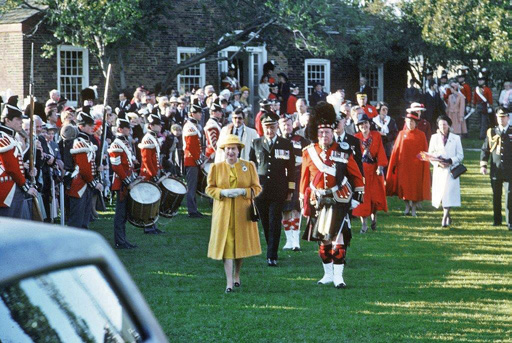
The Crown is an institution that casts a wide net over a history shared by millions of people that goes back more than a millennium. For Canada, it is the bedrock of our democracy, including the Treaties and other Crown-Indigenous relationships that are meant to animate the life of this land.
When it was feared in the last century that Prime Minister Pierre Trudeau was minimizing the role of the Crown in Canada’s federation (the infamous Bill C-60), provincial premiers ensured it was entrenched during the negotiations that led to the Constitution Act (1982). Indeed, thanks to their efforts to protect the provincial sovereignty (which is embodied by the provincial Crowns), our constitutional monarchy became the most protected in the Commonwealth.
During the heady days of 1990, when Quebec’s future in the federation seemed to be unraveling before our eyes, The Queen declared, in person, on Canada Day: “I am not just a fair-weather friend, and I am glad to be here at this sensitive time.” That address (in both French and English) to a crowd of 70,000 people underscored the Queen of Canada’s deep commitment to the country. Some may also recall when Pierre Brassard, a 29-year-old radio show host in Montreal impersonating Prime Minister Jean Chretien in 1995, was connected to The Queen, via telephone, at Buckingham Palace. Unaware she was being pranked with the intention of being made to look foolish, The Queen surprised Brassard by demonstrating her knowledge of recent events and commitment to the federation by immediately agreeing to help her prime minister in the face of the upcoming Quebec Independence Referendum.
This genuine concern for Canada was echoed by her son in his recent commitment, as King, to furthering reconciliation and renewing the Crown-Indigenous relationships threaded into this continent (The Covenant Chain, which allowed for settlers to enter the Great Lakes Region was first established between the Haudenosaunee Confederacy and King Charles II, 1660–1685, and remains in place to this day).
Indeed, The Queen (and Prince Philip) were involved in many important national and international events in the development of this country, including 23 Royal Tours since 1951. Elizabeth II opened the St. Lawrence Seaway (1959), proclaimed the new National Flag (1965), established the Order of Canada (1967) and Order of Military Merit (1972), proclaimed the Constitution Act and Charter of Rights and Freedoms (1982), rededicated the Canadian National Vimy Memorial (2007), unveiled the cornerstone of the Canadian Museum for Human Rights (2010), and created the third Canadian Chapel Royal at Massey College (2017). Whether it was marking the centenary of Confederation (1967), opening and attending the Montreal Olympic Games (1976), or marking the centennials of Manitoba (1970), Northwest Territories (1970), British Columbia (1971), Prince Edward Island (1973), or Saskatchewan and Alberta (2005), Her Majesty was there for moments of unity and celebration. The Queen was also there to share in moments of great sadness as demonstrated by the last official statement of her reign: a message of condolence to the James Smith Cree Nation and people of Weldon, Saskatchewan, following the horrific attacks endured by those communities. “Better days will return,” she assured the Commonwealth in her address during the dark days of the COVID-19 Pandemic. I’m sure many people, including the Royal Family, took comfort as they contemplated anew The Queen’s words, quoting Vera Lynn and alluding to her own Christian faith, at the end of that historic address: “… we will be with our friends again; we will be with our families again; we will meet again.”
Thank you Ma’am.
Original printed pages