← The Fife and Drum / Spring 2021 (Vol 25, No 1)
↗ View this article in the original PDF newsletter
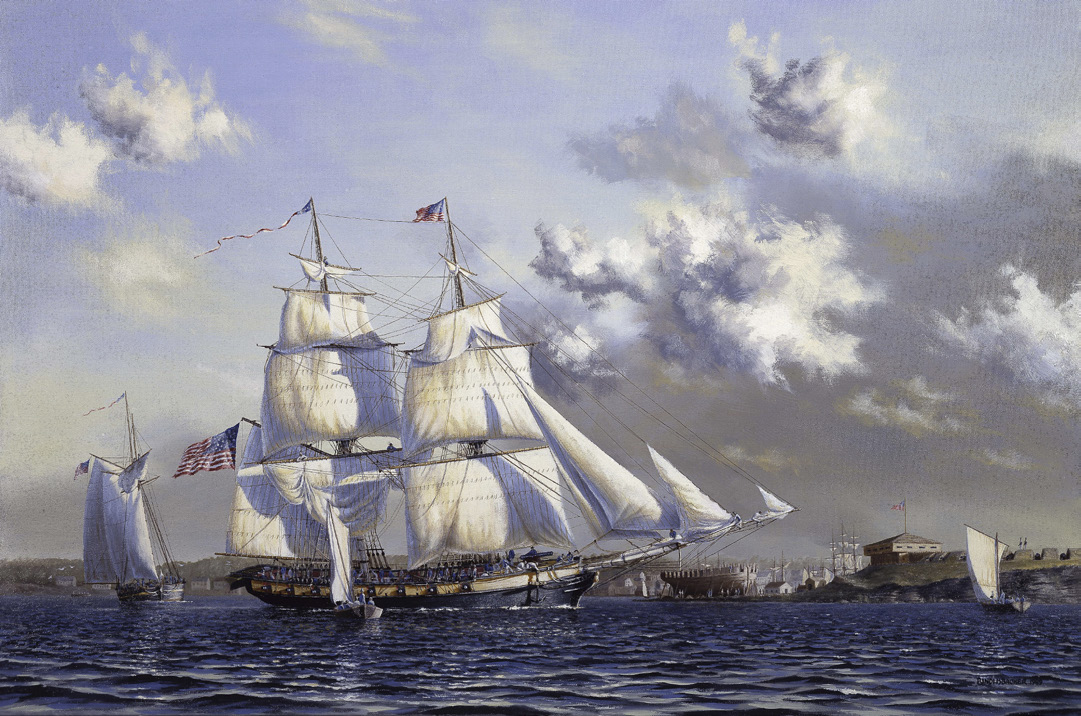
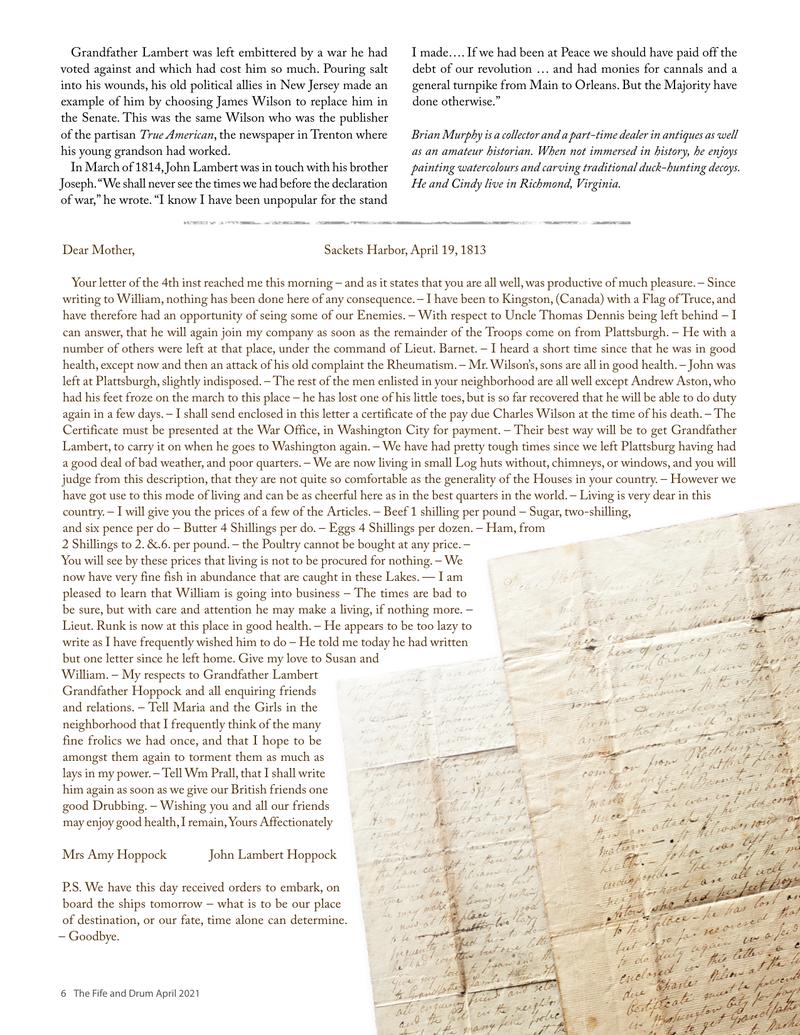
“We have this day received orders to embark, on board the ships tomorrow,” wrote a young officer to his mother on April 19, 1813, from Sackets Harbor. “What is to be our place of destination, or our fate, time alone can determine.” We know now what his destination was – York, at the other end of Lake Ontario – and we know what fate had in store for Captain John Hoppock, a company commander in the newly raised and trained U.S. 15th Regiment of Infantry.
Hoppock’s letter is among a wonderful collection of papers that my wife and I have acquired over the years. They reveal not only some detail of the Battle of York but, more especially, the conditions of service of American soldiers of the period and the warm relationships that animated this young officer’s family. Although cited by Robert Malcomson in Capital in Flames – the definitive account of the Battle of York – the letters below have never before been published.
Born to George and Amy Lambert Hoppock, John Lambert Hoppock was raised in Amwell township, a farming community bordering the east bank of the Delaware River in western New Jersey. After his father died young, John’s mother raised him and his younger siblings, William and Susan, on a large and well-cultivated farm owned by Amy’s father, John Lambert, a gentleman farmer and life-long public servant.
“Grandfather” Lambert (as the family called him) had served in the New Jersey legislature during the 1790s, was acting governor of New Jersey in 1802 and 1803, and represented the state in the U.S. Senate from 1809 to 1815. He would ultimately lose his seat to the politics of the war.
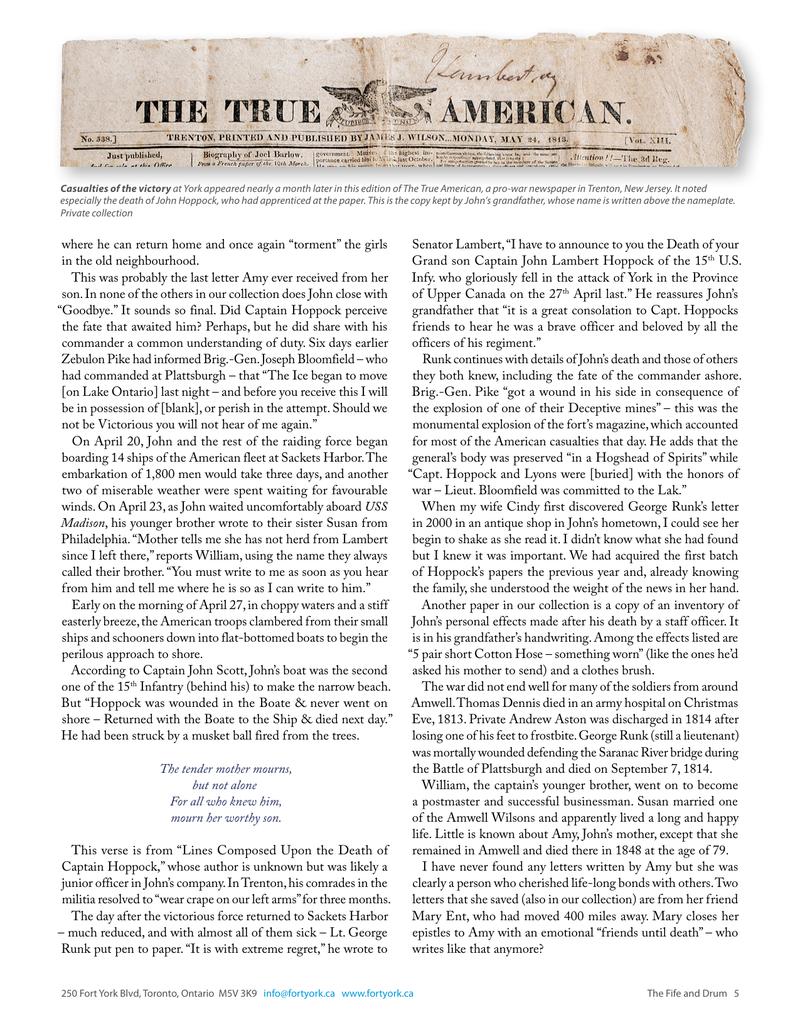
John Hoppock served an apprenticeship at The True American, a newspaper published by James J. Wilson at Trenton, the capital of New Jersey. Wilson, with his own boisterous platform and influential in state politics, was among the “war hawks” who had been clamouring for a showdown with Great Britain. Outside of work, John belonged to a local militia unit, the 1st Light Infantry Company of Trenton. He resolved to seek a commission in the regular army, and it’s not a stretch to believe that Lambert himself delivered his grandson’s request to the Secretary of War.
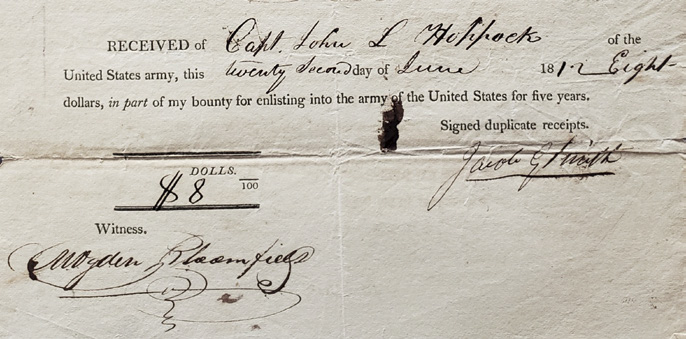
John Hoppock received his captain’s commission in March, 1812, as part of an expansion of the army newly authorized by Congress. He was assigned to Colonel Zebulon Montgomery Pike’s 15th Regiment of Infantry, sometimes just called Pike’s Regiment or The New Jersey Regiment. Col. Pike, already a famous explorer, was a rising star in the growing army. John was likely in his early to mid-twenties at the time and began recruiting volunteers in and around Coryell’s Ferry (later Lambertville) on the Delaware River. The old stone tavern near the ferry landing was likely the local recruiting headquarters, and a recently commissioned neighbour, Ensign John Scott, was part of his team.
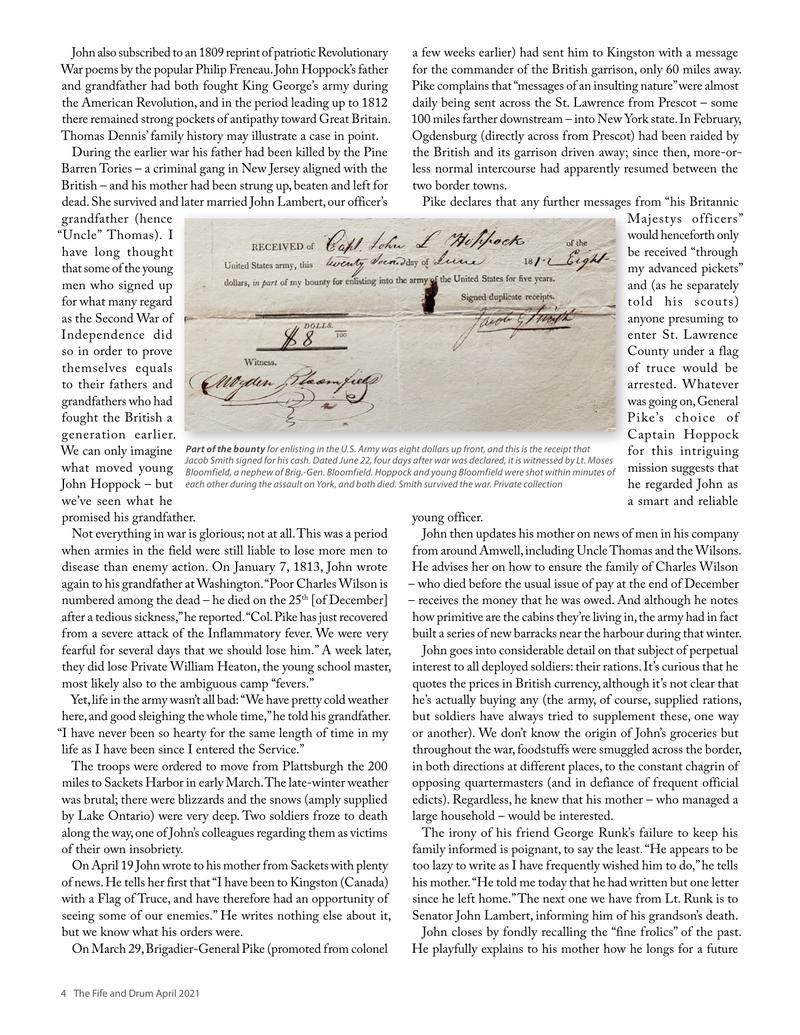
One of the first to enlist was a 41-year-old relative, Thomas Dennis, a wheelwright by trade. The first recruits were often friends, neighbours and relatives, indicating the importance of personal connections in the search for volunteers. Other neighbours who took the oath were 29-year-old Andrew Aston, a farmer, and Charles Wilson, a 21-year-old weaver. Four other Wilsons also enlisted – Oakum, Christopher, John and Joseph – and all five were probably brothers. Most recruits were farmers, laborers and tradesmen, and many signed their enlistment papers with a simple X. William Heaton, a school master by profession, was an exception, autographing his name with a great flair.
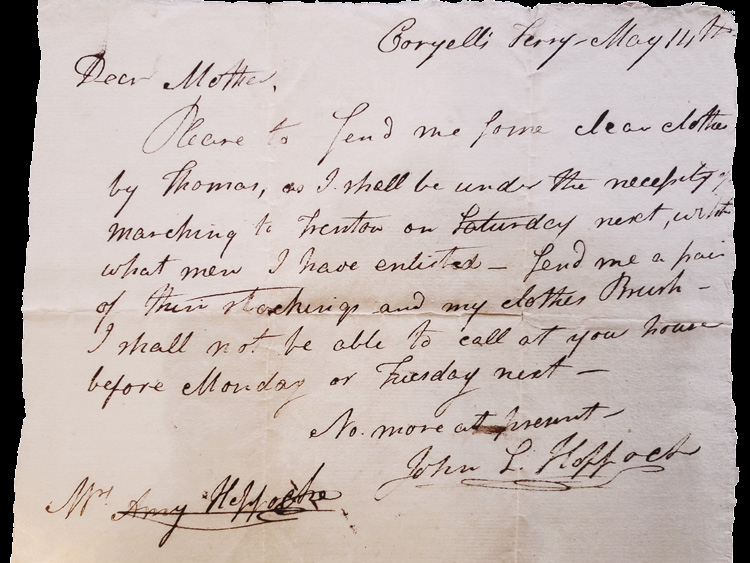
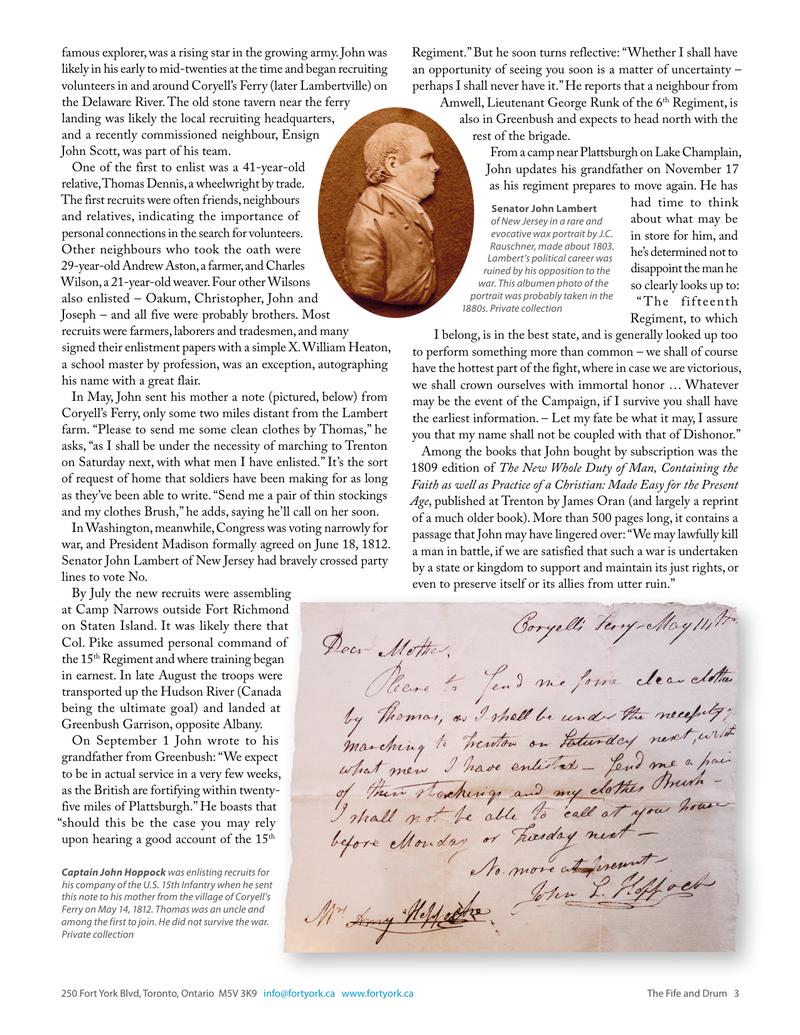
In May, John sent his mother a note from Coryell’s Ferry, only some two miles distant from the Lambert farm. “Please to send me some clean clothes by Thomas,” he asks, “as I shall be under the necessity of marching to Trenton on Saturday next, with what men I have enlisted.” It’s the sort of request of home that soldiers have been making for as long as they’ve been able to write. “Send me a pair of thin stockings and my clothes Brush,” he adds, saying he’ll call on her soon.
In Washington, meanwhile, Congress was voting narrowly for war, and President Madison formally agreed on June 18, 1812. Senator John Lambert of New Jersey had bravely crossed party lines to vote No.
By July the new recruits were assembling at Camp Narrows outside Fort Richmond on Staten Island. It was likely there that Col. Pike assumed personal command of the 15th Regiment and where training began in earnest. In late August the troops were transported up the Hudson River (Canada being the ultimate goal) and landed at Greenbush Garrison, opposite Albany.
On September 1 John wrote to his grandfather from Greenbush: “We expect to be in actual service in a very few weeks, as the British are fortifying within twenty-five miles of Plattsburgh.” He boasts that “should this be the case you may rely upon hearing a good account of the 15th Regiment.” But he soon turns reflective: “Whether I shall have an opportunity of seeing you soon is a matter of uncertainty – perhaps I shall never have it.” He reports that a neighbour from Amwell, Lieutenant George Runk of the 6th Regiment, is also in Greenbush and expects to head north with the rest of the brigade.
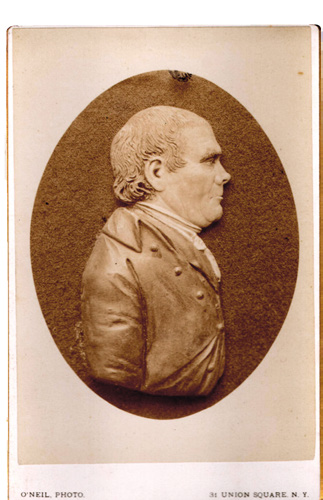
From a camp near Plattsburgh on Lake Champlain, John updates his grandfather on November 17 as his regiment prepares to move again. He has had time to think about what may be in store for him, and he’s determined not to disappoint the man he so clearly looks up to: “The fifteenth Regiment, to which I belong, is in the best state, and is generally looked up too to perform something more than common – we shall of course have the hottest part of the fight, where in case we are victorious, we shall crown ourselves with immortal honor … Whatever may be the event of the Campaign, if I survive you shall have the earliest information. – Let my fate be what it may, I assure you that my name shall not be coupled with that of Dishonor.”
Among the books that John bought by subscription was the 1809 edition of The New Whole Duty of Man, Containing the Faith as well as Practice of a Christian: Made Easy for the Present Age, published at Trenton by James Oran (and largely a reprint of a much older book). More than 500 pages long, it contains a passage that John may have lingered over: “We may lawfully kill a man in battle, if we are satisfied that such a war is undertaken by a state or kingdom to support and maintain its just rights, or even to preserve itself or its allies from utter ruin.”
John also subscribed to an 1809 reprint of patriotic Revolutionary War poems by the popular Philip Freneau. John Hoppock’s father and grandfather had both fought King George’s army during the American Revolution, and in the period leading up to 1812 there remained strong pockets of antipathy toward Great Britain. Thomas Dennis’ family history may illustrate a case in point.
During the earlier war his father had been killed by the Pine Barren Tories – a criminal gang in New Jersey aligned with the British – and his mother had been strung up, beaten and left for dead. She survived and later married John Lambert, our officer’s grandfather (hence the young man’s middle name and status as “Uncle” Thomas). I have long thought that some of the men who signed up for what many regard as the Second War of Independence did so in order to distinguish themselves equals to their fathers and grandfathers who had fought the British a generation earlier. We can only imagine what moved the heart of John Hoppock – but we’ve seen what he promised his grandfather.
Not everything in war is glorious; not at all. This was a period when armies in the field were still losing more men to winter disease than enemy action. On January 7, 1813, John wrote again to his grandfather at Washington: “Poor Charles Wilson is numbered among the dead – he died on the 25th [of December] after a tedious sickness,” he reported. “Col. Pike has just recovered from a severe attack of the Inflammatory fever. We were very fearful for several days that we should lose him.” A week later, they did lose Private William Heaton, the young school master, most likely also to the ambiguous camp “fevers.”
Yet, life in the army wasn’t all bad: “We have pretty cold weather here, and good sleighing – we whole time. We told his grandfather: “I have never been so hearty for the same length of time in my life as I have been since I entered the Service.”
The troops were ordered to move from Plattsburgh the 200 miles to Sackets Harbor in early March. The late-winter weather was brutal; there were blizzards and the snows (amply lubricated by Lake Ontario) were very deep. Two soldiers froze to death along the way, one of John’s colleagues regarding them as victims of their own insobriety.
On April 19 John wrote to his mother from Sackets with plenty of news. He tells her that “I have been to Kingston (Canada) with a Flag of Truce, and have therefore had an opportunity of seeing some of our Enemies.” He writes nothing else about it, but we know what his orders were.
On March 29, Brigadier-General Pike (promoted from colonel a few weeks earlier) had sent him to Kingston with a message for the commander of the British garrison, only 60 miles away. Pike complains that “messages of an insulting nature” were almost daily being sent across the St. Lawrence from Prescot – some 100 miles farther downstream – into New York state. In February, Ogdensburg (directly across from Prescot) had been raided by the British and its garrison driven away; since then, more-or-less normal intercourse had apparently resumed between the two border towns.
Pike declares that any further messages from “his Britannic Majestys officers” would henceforth only be received “through my advanced pickets” and (as he separately told his scouts) so in order to deter anyone presuming to enter St. Lawrence County under a flag of truce would be arrested. Whatever was going on, General Pike’s choice of Captain Hoppock for this intriguing mission suggests that he regarded John as a smart and reliable young officer.
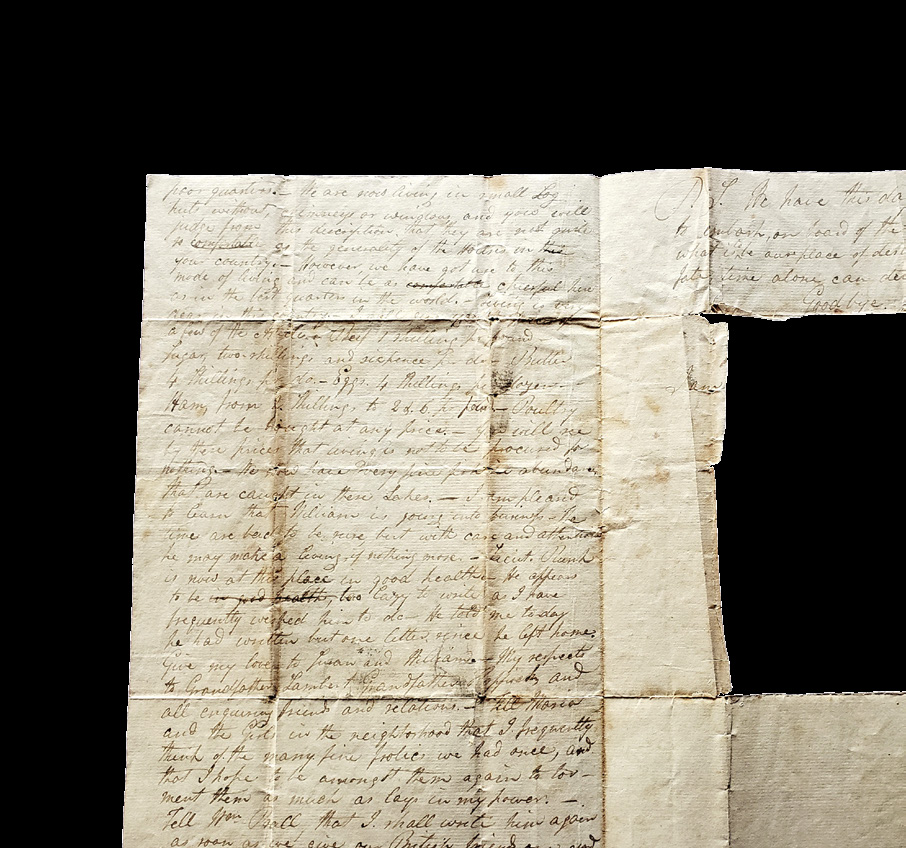
John then updates his mother on news of men in his company from around Amwell, including Uncle Thomas and the Wilsons. He advises her on how to ensure the family of Charles Wilson – who died before the war – is properly paid at the end of December – receives the money that he was owed. And although he notes how primitive are the cabins they’re living in, the army had in fact built up a series of fine barracks near the harbour during that winter.
John goes into considerable detail on that subject of perpetual interest to all deployed soldiers: living rations. It’s curious that he quotes the prices in British currency, although it’s not clear that he’s actually buying any (the army, of course, supplied rations, but soldiers have always tried to supplement these, one way or another). We don’t know the origin of John’s groceries but throughout the war, foodstuffs were smuggled across the border, in both directions at different places, to the constant chagrin of opposing quartermasters (and in defiance of frequent official edicts). Regardless, he knew that his mother – who managed a large household – would be interested.
The irony of Lieut. (now Capt.) George Runk’s failure to keep his family informed is poignant, to say the least. “He appears to be too lazy to write as I have frequently wished him to do,” he tells his mother. “He told me today that he had written but one letter since he left home.” The next one we have from Lt. Runk is to Senator John Lambert, informing him of his grandson’s death.
John closes by fondly recalling the “fine frolics” of the past. He playfully explains to his mother how he longs for a future where he can return home and once again “torment” the girls in the old neighbourhood.
This was probably the last letter Amy ever received from her son. In more of a note off the cuff, he adds a final “Goodbye.” It sounds so final. Did Captain Hoppock perceive the fate that awaited him? Perhaps, but he was with his commander a common understanding of duty. Six days earlier Zebulon Pike had informed the Plattsburgh Bloomfield – who had commanded at Plattsburgh – that “The Ice began to move [on Lake Ontario] last night – and before you receive this I will be in possession of [blank], or perish in the attempt. Should we not be Victorious you will not hear of me again.”
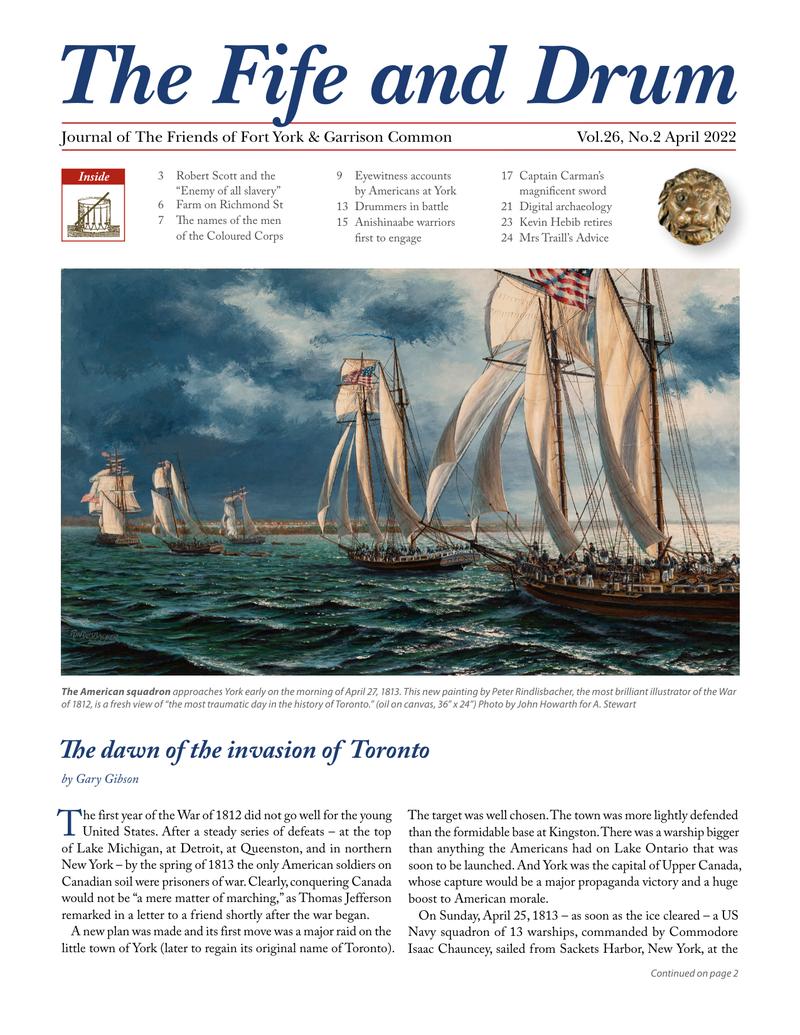
On April 20, John and the rest of the raiding force began boarding 14 ships of the American fleet at Sackets Harbor. The embarkation of 1,800 men would take three days, and another two of miserable weather were spent waiting for favourable winds. On April 23, as John waited uncomfortably aboard USS Madison, his young brother wrote to their older Susan from Philadelphia. “Mother tells me she has not herd from Lambert since I left there,” reports William, using the name the always called their brother. “You must write to me as soon as you hear from him and tell me where he is so as I can write to him.”
Early on the morning of April 27, in choppy waters and a stiff easterly breeze, the American troops clambered from their small ships and schooners down into flat-bottomed boats and began perilous approach to shore.
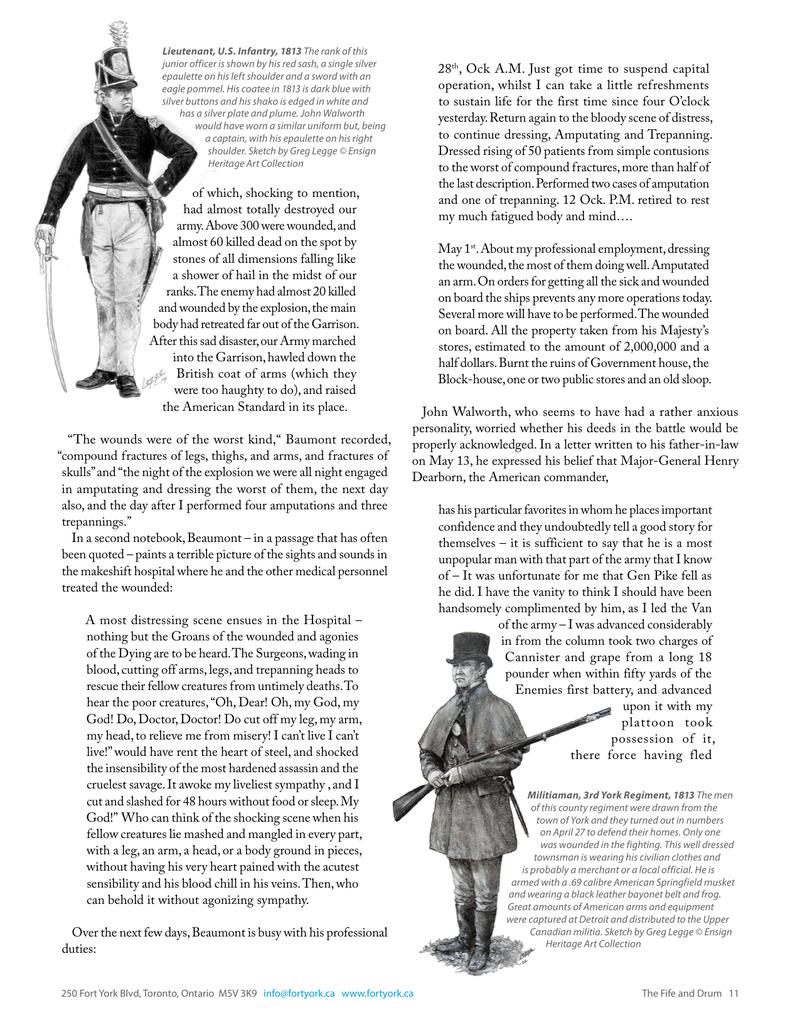
According to Captain John Scott, John’s boat was the second one of the 1st Infantry Regiment to make the narrow beach. But “Hoppock was wounded in the Boate & never went on shore – Returned with the Boate to the Ship & died next day.” He had been struck by a musket ball fired from the trees.
The tender mother mourns,
but not alone
For all who knew him,
mourn her worthy son.
This verse is from “Lines Composed Upon the Death of Captain Hoppock,” whose author is unknown but was likely a junior officer in John’s company. In Trenton, his comrades in the militia resolved to “wear crape on our left arms for three months.
The day after the victorious force returned to Sackets Harbor – much reduced, and with almost all of them sick – Lt. George Runk put pen to paper. “It is with extreme regret,” he wrote to Senator Lambert, “I have to announce to you the Death of your Grand son Captain John Lambert Hoppock of the 15th U.S. Infy. who gloriously fell in the attack of York in the Province of Upper Canada on the 27th April last.” He reassures John’s grandfather that “it is a great consolation to Capt. Hoppocks friends of the circumstances he was a brave officer and beloved by all the officers of his regiment.”
Runk continues with details of John’s death and those of others they both knew, including the fate of the commander ashore. Brig.-Gen. Pike “got a wound in his side in consequence of the explosion of one of their Deceptive mines” – this was the monumental explosion of the fort’s magazine, which accounted for most of the American casualties that day. He adds that the general’s body was preserved “in a Hogshead of Spirits” while “Capt. Hoppock and Lyons were [buried] with the honors of war – Lieut. Bloomfield was committed to the Lak.”
When my wife Cindy first discovered George Runk’s letter in 2000 at an antique shop in John’s hometown, I could see her begin to shake as she read it. I didn’t know what she had found but I knew it was important. We had acquired the first batch of Hoppock’s papers the previous year and, already knowing the family, she understood the weight of the news in her hand.

Another paper in our collection is a copy of an inventory of John’s personal effects made after his death by a staff officer. It is that of a grandfatherly nature. Among the effects listed are “5 pair short Cotton Hose – something worn” (like the ones he’d asked his mother to send) and a clothes brush.
The war did not end well for many of the soldiers from around Amwell. Thomas Dennis died in an army hospital on Christmas Eve, 1813. Private Andrew Aston was discharged in 1814 after losing one of his feet to frostbite. George Runk (still a lieutenant) was mortally wounded defending the Saranac River bridge during the Battle of Plattsburgh and died on September 7, 1814.
William, the captain’s younger brother, went on to become a postmaster and successful businessman. Susan married one of the Amwell Wilsons and apparently lived a long and happy life. Little is known about Amy, John’s mother, except that she remained in Amwell and died there in 1848 at the age of 79.
I have never found any letters written by Amy but she was clearly a person who cherished life-long bonds with others. Two letters that she saved (also in our collection) are from her friend Mary Ent, who had moved 400 miles away. Mary closes her epistles to Amy with an emotional “friends until death” – who writes like that anymore?
Grandfather Lambert was left embittered by a war he had voted against and which had cost him so much. Pouring salt into his wounds, his old political allies in New Jersey made an example of him by choosing James Wilson as his successor to the Senate. This was the same Wilson who was the publisher of the partisan True American, the newspaper where his young grandson had worked.
In March of 1814, John Lambert was in touch with his brother Joseph. “We shall never see the times we had before the declaration of war,” he wrote. “I know I have been unpopular for the stand I made.… If we had been at Peace we should have paid off the debt of our revolution … and had monies for canals and a general turnpike from Main to Orleans. But the Majority have done otherwise.”
Sources & Further Reading
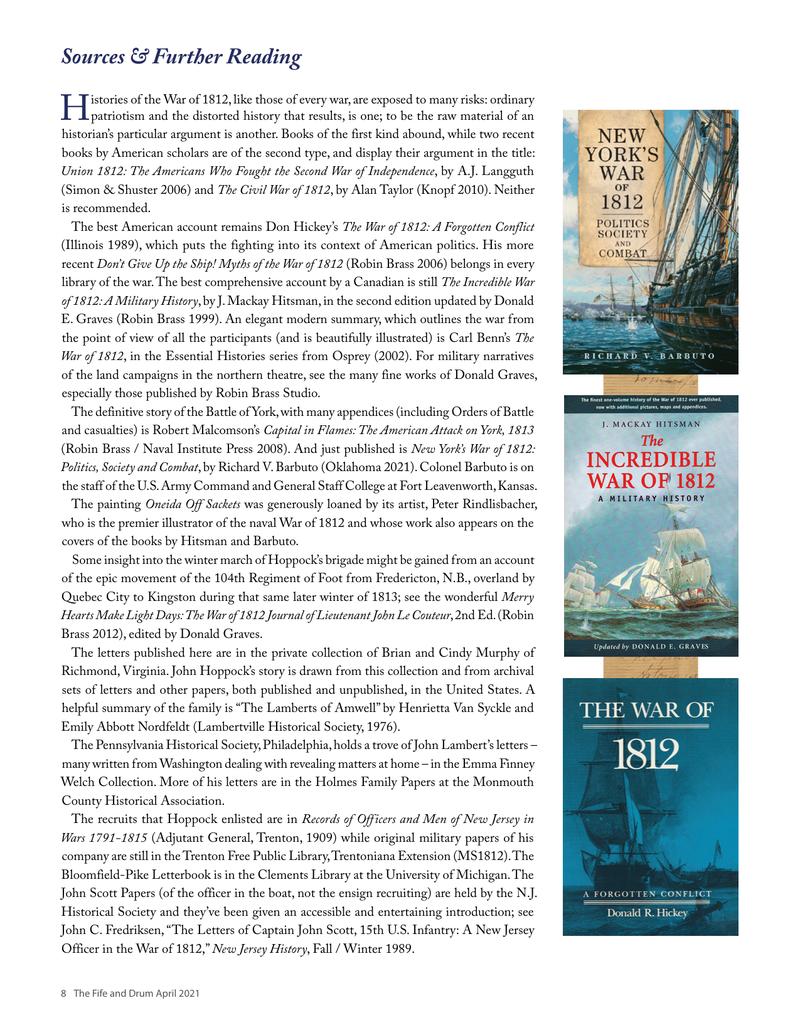
Histories of the War of 1812, like those of every war, are exposed to many risks: ordinary patriotism and the distorted history that results, is one; to be the raw material of an historian’s particular argument is another. Books of the first kind abound, while two recent books by American scholars are of the second type, and display their argument in the title: Union 1812: The Americans Who Fought the Second War of Independence, by A.J. Langguth (Simon & Shuster 2006) and The Civil War of 1812, by Alan Taylor (Knopf 2010). Neither is recommended.
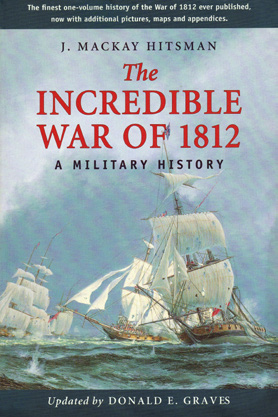
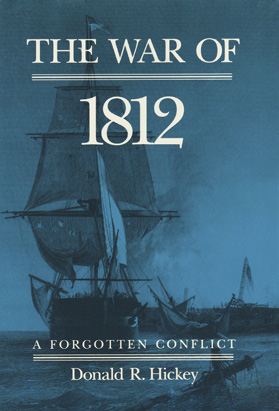
The best American account remains Don Hickey’s The War of 1812: A Forgotten Conflict (Illinois 1989), which puts the fighting into its context of American politics. His more recent Don’t Give Up the Ship! Myths of the War of 1812 (Robin Brass 2006) belongs in every library of the war. The best comprehensive account by a Canadian is still The Incredible War of 1812: A Military History, by J. Mackay Hitsman, in the second edition updated by Donald E. Graves (Robin Brass 1999). An elegant modern summary, which outlines the war from the point of view of all the participants (and is beautifully illustrated) is Carl Benn’s The War of 1812, in the Essential Histories series from Osprey (2002). For military narratives of the land campaigns in the northern theatre, see the many fine works of Donald Graves, especially those published by Robin Brass Studio.
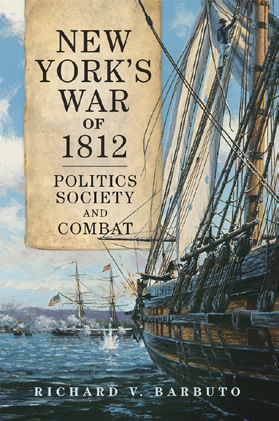
The definitive story with many appendices (including Orders of Battle and casualties) is Robert Malcomson’s Capital in Flames: The American Attack on York, 1813 (Robin Brass / Naval Institute Press 2008). And just published is New York’s War of 1812: Politics, Society and Combat, by Evan C. Rothera and Richard V. Barbuto (Colonel Barbuto is the staff of the U.S. Army Command and General Staff College at Fort Leavenworth, Kansas.
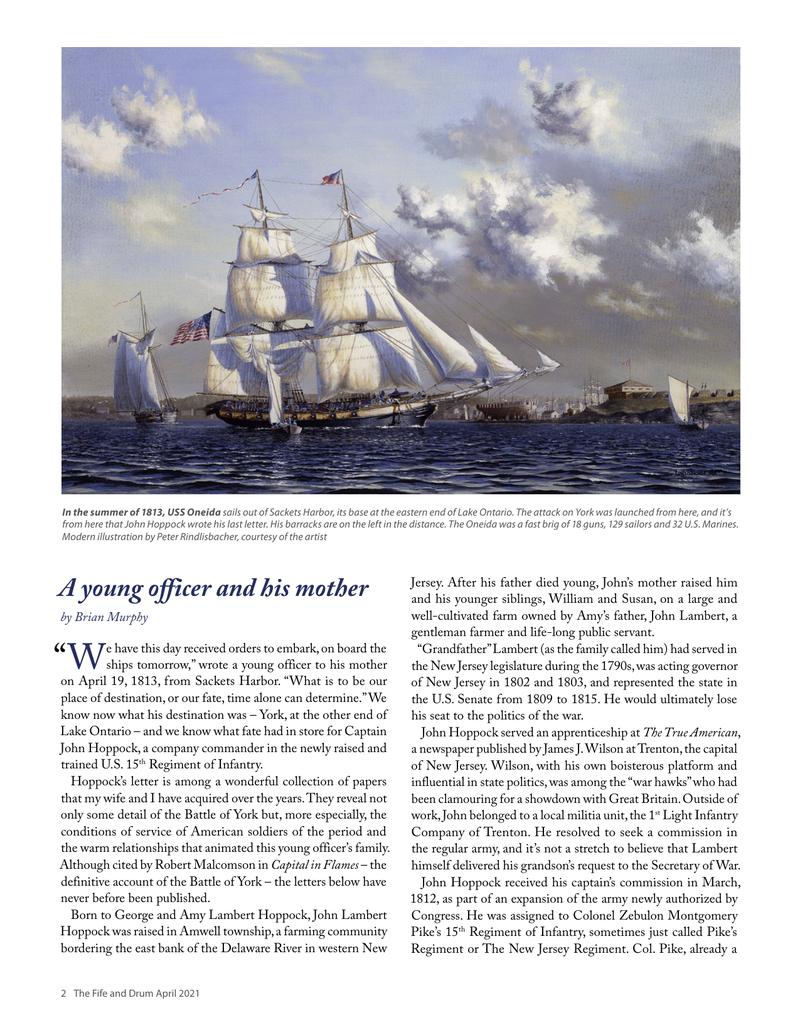
The painting Oneida Off Sackets was generously loaned by its artist, Peter Rindlisbacher, who is the premier illustrator of the naval War of 1812 and whose work also appears on the covers of the books by Hitsman and Barbuto.
Some insight into the winter march of Hoppock’s brigade might be gained from an account of the epic movement of the 104th Foot Regiment of Foot from Fredericton, N.B., overland by Quebec City to Kingston during that same later winter of 1813; see the wonderful Merry Hearts Make Light Days: The War of 1812 Journal of Lieutenant John L: Conteur, 2nd Ed. (Robin Brass 2012), edited by Donald Graves.
The letters published here are in the private collection of Brian and Cindy Murphy of Richmond, Virginia. John Hoppock’s story is drawn from this collection and from archival sets of letters and other papers published and unpublished, in the United States. A helpful summary of the family is “The Lamberts of Amwell” by Henrietta Van Syckle and Emily Abbott Nordfeldt (Lambertville Historical Society, 1976).
The Pennsylvania Historical Association Society, holds books of John Lambert’s letters – many written from Washington dealing with revealing matters at home – in the Emma Finney Welch Collection. More of his letters are in the Holmes Family Papers at the Monmouth County Historical Association.
The recruits that Hoppock enlisted are in Records of Officers and Men of New Jersey in Wars 1791-1815 (Adjutant General, Trenton, 1909) while original military papers of his company are still in the archived Bloomfield-Pike Letterbook in Pennsylvania Extension (MS1812). The Bloomfield-Pike Letterbook is in the Clements Library at the University of Michigan. The John Scott Papers (of the officer in the boat, not the ensign recruiting) are held by the N.J. Historical Society and they’ve been given an accessible and entertaining introduction; see John C. Fredriksen, “The Letters of Captain John Scott, 15th U.S. Infantry: A New Jersey Officer in the War of 1812,” New Jersey History, Fall / Winter 1989.
Original printed pages