This article will outline British and Canadian strategy, developed in the decade following the War of 1812, to deter and defend against any American invasion of the northern colonies. It is also a story of the Board of Ordnance, little known in Canada but the agency then responsible for Imperial military policy and fortification – including the defence of British North America.
Tremendous cost overruns in defence spending and debates about industrial and economic spin-offs are nothing new. While the scale and repercussions of what became a vast defence program are little remembered today, those parts of it that were built are now among our finest tourist attractions – to Canadians and Americans alike!
The War of 1812 revealed three inherent weaknesses in the Canadian position. First was the geographical vulnerability of Upper Canada: the St. Lawrence River was the lifeline of the province. Along the great river came food, manufactures and, in time of war, troops and materiel. The Americans needed only to choose where to cross, to cut the route, and thereby isolate Upper Canada. Second, there would never be enough regular troops to cover the entire frontier. Finally, the population was too small, especially in Upper Canada, to provide economic support and a strong militia.
For the British, the strategic conditions of war were clear enough. British North America’s population and resources were grossly inferior to those of the United States. On land, the Americans could easily invade and occupy large areas of Canada for short periods of time, but could they capture the strongholds? Their logistics were little better than those of the British and neither found it possible for an army to subsist on the produce of Upper Canada. On the high seas, American privateers, fashioned out of the second largest merchant marine in the world, had successfully raided the British merchant trade with Canada and the West Indies (even while Maritime privateers preyed on American trade). All of this emphasized the importance of communications. Britain had the naval strength to ultimately protect its maritime trade, blockade the enemy and harass his coastal cities. But even Great Britain could not conquer the United States. There was also Britain’s growing trade with America, which it did not want to lose. Since the end of the War of Independence, British policy had balanced political responsibilities to the Canadian colonies with the economic opportunities offered by the neighbouring republic.
The Americans began improving their access to the Great Lakes in 1817 by building the Erie Canal to Buffalo. Side branches to Lake Champlain in 1819 and to Oswego in 1828 shifted the trade and military balance of the region toward the United States. The British, with the world’s mightiest empire, could not abandon their colonies to this upstart nation. What could they do to defend them?
The Smyth Report
An appreciation of the lessons learned in the war – and an outline of what to do about them – was drafted by Lieutenant-Colonel Sir John Harvey and given to the Governor General and Commander of Forces, the Duke of Richmond, in 1819. Lt.-Col. Harvey had distinguished himself at the Battle of Stoney Creek in 1813 and knew well the problems of the campaign.
Operations on the frontier must be defensive and designed to resist, dissipate and defeat an invasion
The Duke of Richmond also had excellent military credentials and was a trusted friend of the Duke of Wellington, who was now the Master General of the Ordnance, responsible for the permanent defences of the Empire.
The Duke of Richmond inspected the provinces personally. He sent his appreciation to Wellington in 1819, generally approving of Harvey’s work. Wellington replied with encouraging comments to Lord Dalhousie, the new Governor General. Little was done.
But a new war scare in 1824 led Wellington to instruct Sir James Carmichael Smyth, his Chief Engineer during the late war and now a major-general, to recommend the fortifications and manpower – and to estimate the cost – needed to put a plan for Canadian defence into effect.
The preliminary Smyth Report was dated September 9, 1825, and followed by a more detailed report in February that projected a total cost of £1,646,218. Wellington approved. “I do not entertain the smallest doubt,” he wrote to Lord Bathurst, Secretary of War and the Colonies, “that if the communications and works proposed…are carried into execution, His majesty’s dominions in North America ought to be, and would be, effectually defended and secured against any attempt to be made upon them hereafter by the United States, however formidable their power.”
Wellington (who became Prime Minister in 1828) and his successors at the Board of Ordnance tried hard for the next 25 years to implement Smyth’s plan despite declining military spending and major budget overruns. Financial trouble at the Ordnance, mainly in the Canadas, led to its complete reorganization within the new War Office in 1848. Expenditures in British North America for barracks, fortifications and communications had by then amounted to £2,769,005, a 68% cost overrun. This was three quarters of the sum spent across the entire Empire!
And there were two further costs: the funds expended by the Colonial Office for roads, canals and legal expenses, including settlements for related land disputes; and those of the Commissariat branch, which provided the food, clothing, interim lodging and transportation for military and naval personnel in Canada. This was an additional £100,000 to £150,000 per year.
Wellington knew that the forces given to Canadian defence could not – in a context of growing austerity – be greater than the maximum effort of the previous war: 13,500 troops. Even so, he thought this would be enough to hold up a numerically superior force until reinforcements arrived.
Wellington would not get nearly that many soldiers. Instead of two trained corps of 5,000 men each in the field and a total garrison of 13,500 men in the two Canadas, there were on the eve of the rebellions in 1837 only about 5,000 soldiers in all of British North America. Instead of an organized and trained force of 40,000 militia, there was a vast paper army of nearly 250,000 Sedentary Militia, essentially all the men between 18 and 60 years of age. Although several county battalions were raised and trained hard for more than a year in the wake of the rebellions – and were housed in new barracks at the crumbling New York and on Bathurst Street, at Queen – these units were soon stood down. What remained was referred to as the Active Militia, men up to the age of 40 required to muster once a year.
A strategic balance
While implementation advanced slowly as funds permitted, and never came close to Smyth’s entire plan, those fortifications, roads and canals that were built did greatly improve the military potential of the colonies. There was also a consensus on the general strategy.
Operations on the frontier must be defensive and designed to resist, dissipate and defeat an invasion. Forts and posts would hold off or delay the enemy on his principal lines of attack, the defenders falling back if necessary upon the bastions protecting the communications with Britain. The main effort would therefore be the defence of five fortresses: Halifax, Quebec, Montreal, Kingston and Niagara. With regular troops holding these, and with militia harassing their flanks and rear, the Americans would not be able to consolidate their grip on the provinces. The British could then counterattack with reinforcements in the spring, when ships could once more reach Quebec.
Timing was important. Winter would probably help the Americans because it was shorter for them and prevented reinforcement by the British. But it would also prevent any lengthy siege operations against the planned fortresses. The best chance for the Americans, therefore, would be an attack in late winter or early spring, completing their campaign before British help could arrive.
Communication and reinforcement in British North America relied on water transportation. There was no road to Lower Canada from the Maritimes and the only one between Quebec and Amherst near the west end of Lake Erie) was 700 miles long and most useful in winter. During spring and summer, the British position was much better. The comparative invulnerability of Halifax – by way of a presumed naval superiority and the impracticability of a major land attack through the woodlands of Maine and New Brunswick – ensured British command of the St. Lawrence to Quebec. But no farther.
A more secure line of communication was needed from Montreal to Kingston and the upper lakes. While the British dreamed of arming civilian steamboats to create an ad-hoc navy, the Americans had the same ideas and controlled three quarters of Great Lakes shipping. The Royal Navy eventually conceded that it could not gain naval supremacy upstream of Montreal. This depressing situation for the British was matched by a similar but different situation for the Americans; a situation that, for a time, balanced the vulnerability of the Canadas.
The War of 1812 showed clearly the exposure of American coastal cities to heavy raids by the Royal Navy. Baltimore and New Orleans had escaped destruction, but Washington had not, and Smyth thought New York should share its fate in the next war. This the Americans well knew, and an official report in 1840 reminded them that their great cities also held their main population and incendiaries. New York City suggested the probable result of a rain of incendiary shells.
Americans spent vast sums building fortifications along their Atlantic seaboard and the Gulf Coast
As a consequence, the Americans spent vast sums building fortifications along their Atlantic seaboard and the Gulf Coast. The forts were described as “incomplete, unfinished, and unarmed” as late as 1837, when all required extensive and costly repairs. Nor were there troops to man them. The US Army boasted only 6,000 regulars in 1821, and only 4,000 by 1835 (and few of them faced north). America’s chief strength was in its state militias, whereas Canada’s strength was still in its British regulars.
Executing the plan
In the Maritimes, the budget developed by Smyth generally held. Halifax was the cornerstone of Canadian security and British defence policy in the North Atlantic. The Citadel was to be rebuilt at a cost of £160,000 together with subsidiary forts and batteries intended to protect the naval dockyard. Forts at Annapolis and Windsor would prevent a land-based attack on Halifax from the Bay of Fundy. The tidal port of Saint John was to be protected by a new battery on its approaches.
Smyth had recommended two roads to connect the Maritimes with Quebec to allow reinforcements to arrive before the spring breakup in the St. Lawrence. One went from Quebec to Fredericton and Saint John, a distance of 447 miles, by way of Lake Temiscouata and the Saint John River. Large parts of the road existed but it ran along the American border, easily cut in war; £40,000 were nevertheless committed to complete the remaining sections. By the 1840s the route was in regular use and it is now part of the Trans-Canada Highway. The second route – from Quebec to Moncton to Halifax, more secure but 1000 miles through largely unsurveyed land – was left to provincial legislatures and the march of time.
In Lower Canada, indecision around how to best repel an attack down the Richelieu River is reflected in the cost over-
runs. Against original estimates of £180,000, total costs in the province ballooned to £980,209.
The Quebec Citadel was upgraded to withstand almost any conceivable siege. A planned Montreal citadel, on the other hand, faced no end of opposition. The walls of Montreal had been demolished in 1817 to allow the city to expand. A fortress was originally proposed for Place des Armes, but citizens objected to the demolition of a newly rebuilt city centre. The top of Mount Royal was recommended by some, though there were other proponents, and the communication route would be in front of the fortress, subject to capture and use in a siege.
Consequently, a plan evolved to build small forts or batteries on the likely landing sites for the upper the island of Montreal. These places were Cascades, Chateauguay, La Prairie, Longueuil and Bout d’Îsle.
Smyth thought the Welland Canal was too close to the border and, like Wellington, believed a fortress would be essential
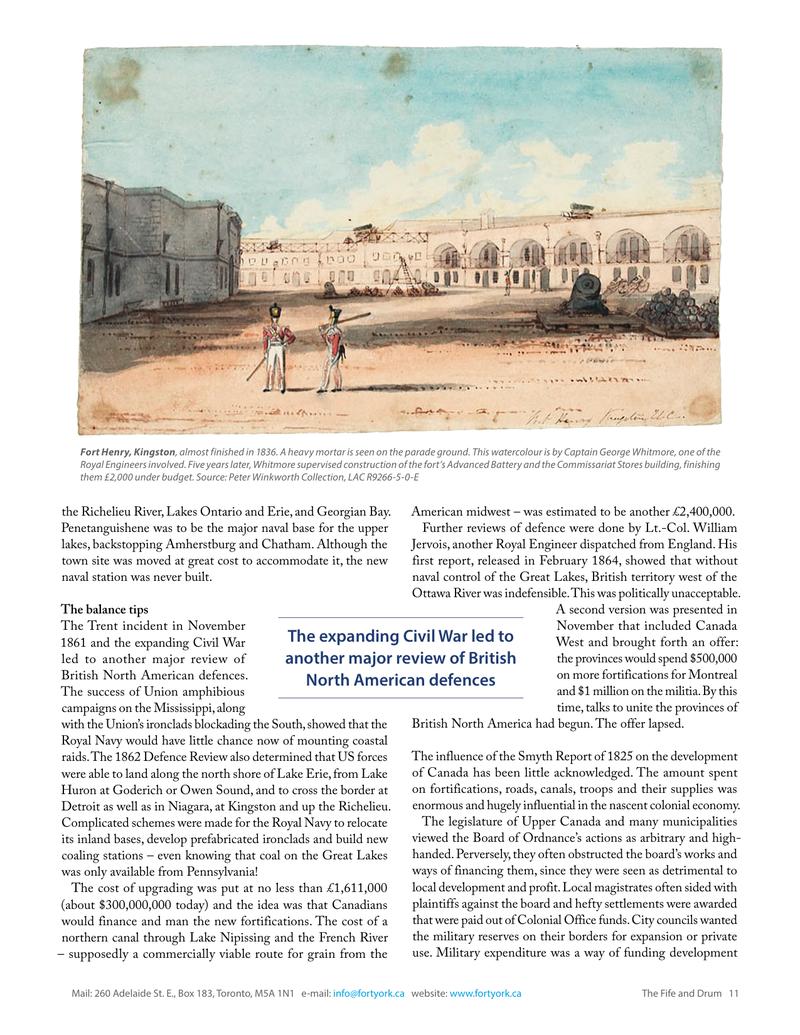
The forts along the Richelieu river were on the six miles north of the border with Fort Lennox at Isle-aux-Noix. Smyth planned minor improvements to the existing works but Wellington insisted on more, by 1829 (and £86,740) Fort Lennox had been rebuilt. The fort at St. Jean, where substantial improvements were also made, protected the place where an attacking force declared whether it was after Montreal or Quebec. The closer portage to Montreal, it was also the terminus of Canada’s first railway in 1836 and it protected the naval depot of the Lake Champlain and Richelieu River flotillas. St. Jean is still an important military base. Chambly, farther downstream, was also to be rebuilt but (thankfully for us) little was done and the French stone fort, built in 1711, was preserved. Some of the money probably went into the Chambly Canal, which by 1840 connected Chambly and St. Jean.
Canals
Before the railways, and when roads were few and muddy, it was lakes, rivers and canals that connected the population centres and military outposts of British North America. Two important aspects of the canal system, however, should be noted.
First was the complexity of its administration, owing to the fact that its various components were governed by different jurisdictions. The Lachine canal was controlled by Montreal, the Vaudreuil lock by a private company, the St. Anne’s lock by Lower Canada, and the Carillon, Chute-à-Blondeau, Grenville and Rideau military canals by the Ordnance from London. The Welland Canal was a private enterprise taken over by Upper Canada in 1841.
Second, the objectives of these canals were as varied as their owners. Building standards and dimensions varied and were never harmonized, and so much of the expenditure and effort was futile. By the mid 1840s, even the new Rideau Canal (finished in 1832) was obsolete for Great Lakes shipping.
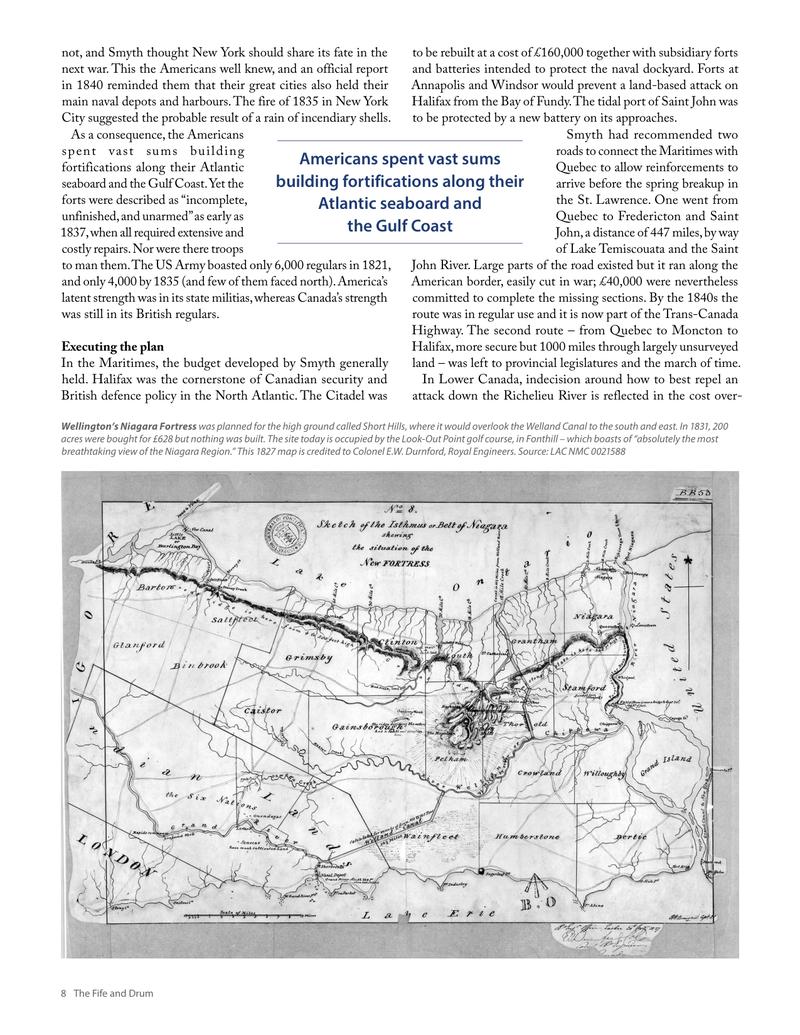
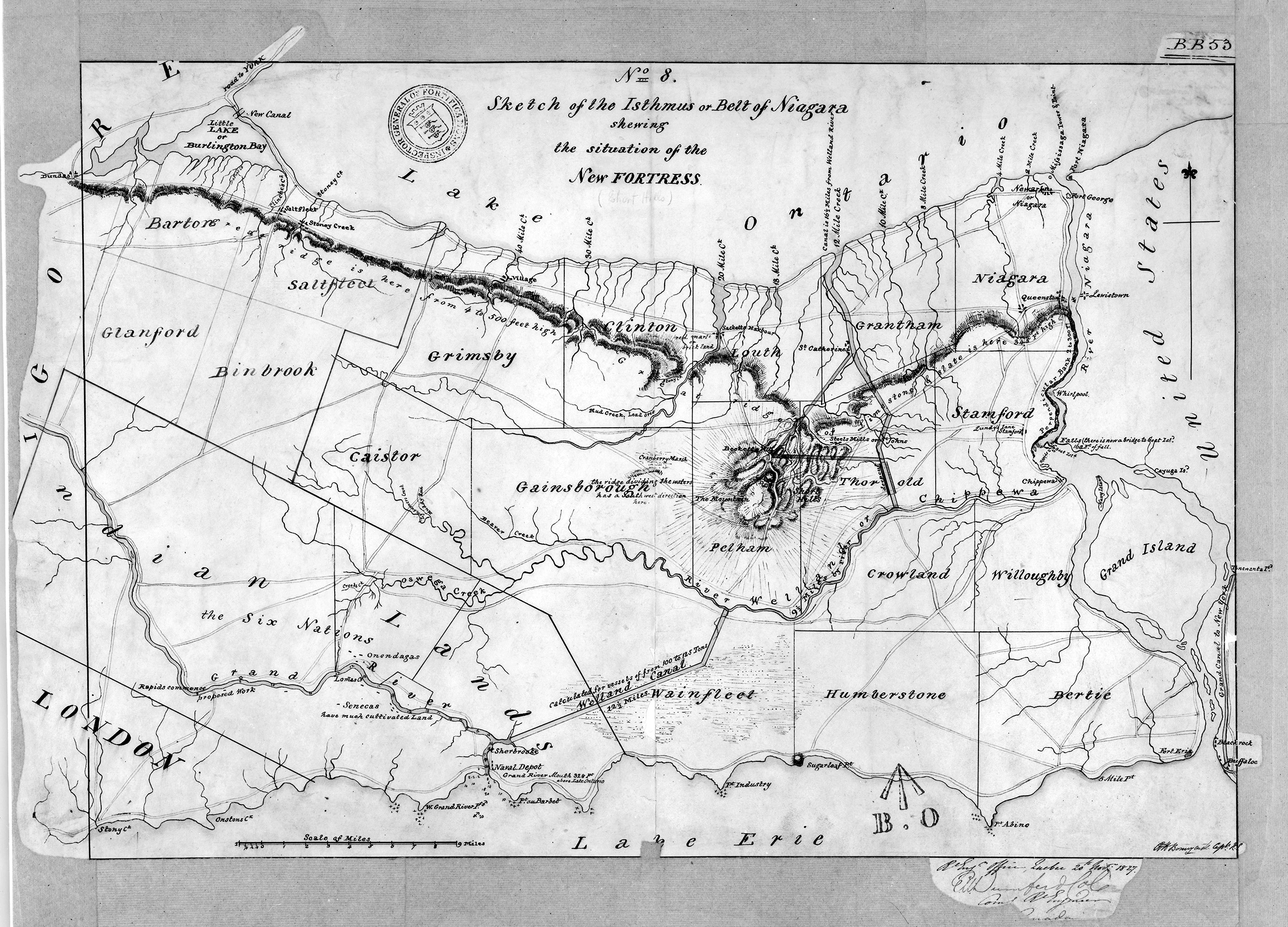
The Niagara peninsula in the 1820s was still sparsely settled away from the river. It’s easy to imagine local competition for the route of a Niagara canal, for growth along it would be assured. Smyth thought the Welland Canal was too close to the border

and, like Wellington, believed a fortress would be essential to its security in war. The Royal Navy wanted the canal to start in Hamilton and terminate in the Grand River at its revised depot at Caledonia. However, the Welland Canal Company, having obtained its financing from New York faster than its competitors, had already started work.
There were also various studies of a canal connecting the Ottawa River to Georgian Bay and the naval depot at Penetanguishene, a route that would avoid the vulnerability of those closer to the border. This was a pet project of the Duke of Richmond from 1819 into the 1830s and the Royal Engineers during their hardest to please the great man. Survey parties were dispatched to find a route – some of them plotted through what is now Algonquin Park – but the idea went nowhere.
Revising the plan
For two decades after the opening of the Rideau Canal, Wellington’s views about defending the interior defence of Upper Canada. However, during the Oregon Crisis of 1845-46, the Ordinance concluded that Kingston could not be defended against a combined land and sea assault unless a large field army covered the land approaches. At Kingston, Smyth had been fixated with the naval threat, Martello towers were erected to protect the dockyard from bombardment by steam warships, which could venture closer to shore than sailing vessels.
The British government was still in no mood to provide the money for the 13,000 British troops the Ordinance always considered necessary. Canada, it believed, should provide the money and troops for its own protection, not the British taxpayer. As for all the military canals, originally estimated to cost £279,000, the Ordinance in the 1840s stopped tracking the overruns – Parliament was threatening to shut down the Ordinance because of them — when £1,241,813 had already been spent!

By 1848 the Ordinance was at trouble with Parliament for unapproved spending, especially on the Rideau Canal, and economies became necessary. Sales of the Ordinance’s extensive properties were used to finance what little construction was immediately required. The legislature and most towns hesitated to buy Ordinance land, however, wanting it to be donated instead, asserting that the funding of fortifications was a British responsibility.
The projects in Upper Canada, scheduled later in the plan, consequently suffered or were sacrificed in order to fund the overruns on projects protecting Kingston and Montreal. Wellington thought Kingston was crucial to the defence of Montreal and Quebec. And the proximity of the Welland Canal to the border, and across one of the major attack routes envisioned, reinforced Wellington’s demand for a substantial fortress in the Niagara peninsula long after it was obvious that there was no money to pay for it (and a defence review in 1862 still recommended its construction).
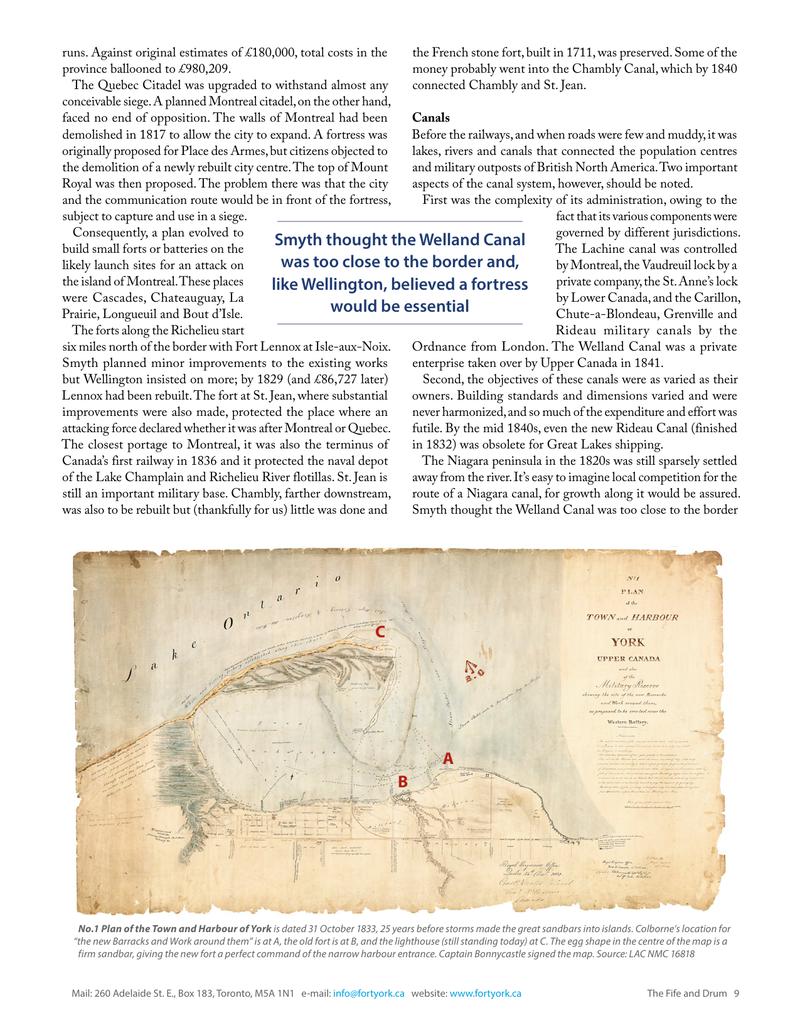
York also paid a price. Although Smyth famously believed that York should never have been chosen as the capital – “It offers no advantages that we are aware of, either of a Civil, Military or Commercial nature” – it would need defending for as long as it remained the seat of government. First proposed in 1827 by the Royal Engineer office at Quebec was a five-sided stone citadel bristling with guns but with barracks for only 200 men. The existing fort would be demolished and this fortress built over a buried Garrison Creek. Nothing was done.
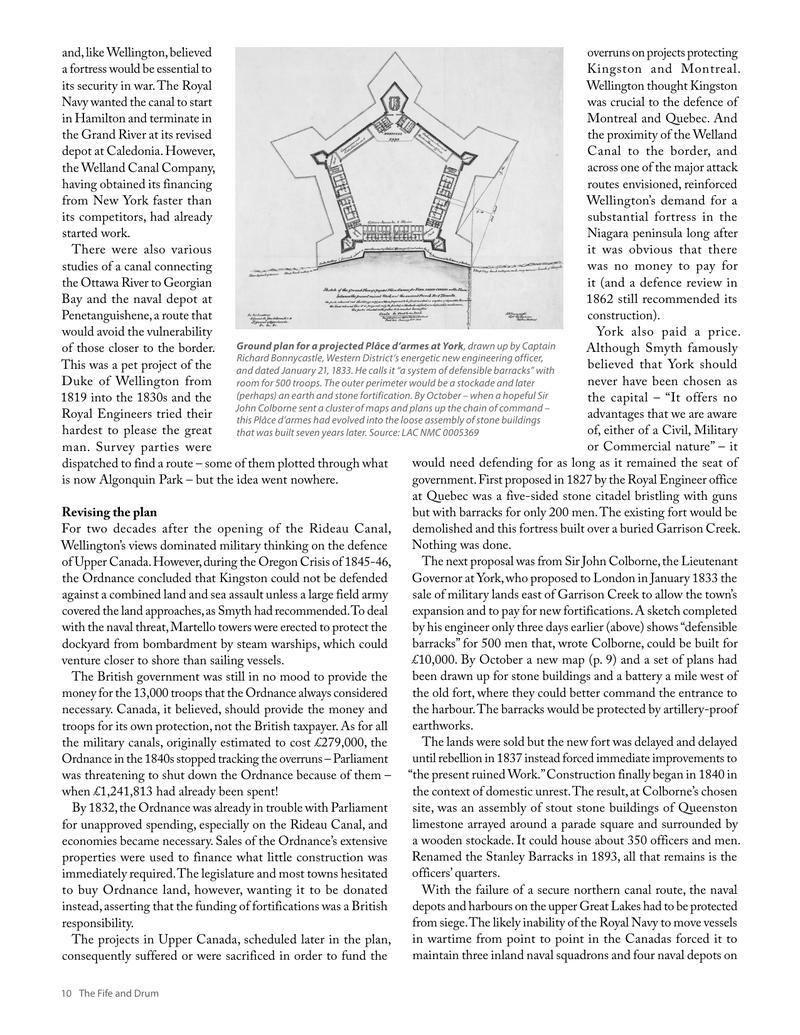
The next proposal was from Sir John Colborne, the Lieutenant Governor at York. He proposed to London in January 1833 the sale of military lands east of Garrison Creek to allow the town’s expansion and to pay for new fortifications. A sketch completed by his engineer only three days earlier (above) shows “defensible barracks” for 500 men that, wrote Colborne, could be built for £10,000. By October a new map (p. 9) and a set of plans had been drawn up for stone buildings and a battery a mile west of the old fort, where they could better command the entrance to the harbour. The barracks would be protected by artillery-proof earthworks.
The lands were sold but the new fort was delayed and delayed until rebellion in 1837 instead forced immediate improvements to “the present ruined Work.” Construction finally began in 1840 in the context of domestic unrest. The result, at Colborne’s chosen site, was an assembly of stout stone buildings of Queenston limestone arrayed around a parade square and surrounded by a wooden stockade. It could house about 350 officers and men. Renamed the Stanley Barracks in 1893, all that remains is the officers’ quarters.
With the failure of a secure northern canal route, the naval depots and harbours on the upper Great Lakes had to be protected from siege. The likely inability of the Royal Navy to move vessels in wartime from point to point in the Canadas forced it to maintain three inland naval squadrons and four naval depots on

the Richelieu River, Lakes Ontario and Erie, and Georgian Bay. Penetanguishene was to be the major naval base for the upper lakes, backstopping Amherstburg and Chatham. Although the town site was moved at great cost to accommodate it, the new naval station was never built.
The balance tips
The Trent incident in November 1861 and the expanding Civil War led to another major review of British North American defences. The states of the Union and Prohibition campaigns on the Mississippi, along with the Union’s ironclads blockading the South, showed that the Royal Navy would have little chance now of mounting coastal raids. The 1862 Defence Review also determined that US forces were able to land along the north shore of Lake Erie, from Lake Huron at Goderich or Owen Sound, and to cross the border at Detroit as well as by Niagara and by the Richelieu. Complicated schemes were made for the Royal Navy to relocate its inland bases, develop prefabricated ironclads and build new coastal defences for a navy that knew the Great Lakes was only available from Pennsylvania!
The expanding Civil War led to another major review of British North American defences
The cost of upgrading was put at no less than £1,611,000 (about $300,000,000 today) and the idea was that Canadians would finance and man the new fortifications. The cost of a northern canal through Lake Champlain and the Richelieu – supposedly a commercially viable route for grain from the American midwest – was estimated to be another £2,400,000. Further reviews of defence were done by Lt.-Col. William Jervois, another Royal Engineer dispatched from England. His first report, released in February 1864, showed that without full control of the Great Lakes, British territory west of the Ottawa River was indefensible. This was politically unacceptable.
A second version was presented in November that included Canada West and brought forth an offer: the provinces would spend $500,000 on more fortifications for Montreal and $1 million on the militia. By this time, talks to unite the provinces of British North America had begun. The offer lapsed.
The influence of the Smyth Report of 1825 on the development of Canada has been little acknowledged. The amount spent on fortifications, roads, canals, troops and their supplies was enormous and hugely influential in the nascent colonial economy.
The legislature of Upper Canada and many municipalities viewed the Board of Ordnance’s actions as arbitrary and highhanded. Perversely, they often obstructed the board’s works and ways of financing them, since they were seen as detrimental to local development and profit. Local magistrates often sided with plaintiffs against the board and hefty settlements were awarded that were paid out of Colonial Office funds. City councils wanted the military reserves on their borders for expansion or private use. Military expenditure was a way of funding development
Original printed pages