Since the very first Haudenosaunee raids were recorded, the five nations of the Confederacy – Mohawk, Oneida, Onondaga, Cayuga, Seneca – and their neighbours – First Nation and European – have offered different explanations of why the Haudenosaunee waged war, and of what that said about their overall aims. The policy of the Haudenosaunee (or the Iroquois, as they’ve been known for so long) has engaged scholars in many fields for more than 200 years.
Some have suggested that warfare was the product of specific features of ‘traditional’ Haudenosaunee culture, such as the need for revenge, while others say that warfare was a result of a new culture and of new economic motives. There are no formal names for these narratives – each of which can be traced to its own historic period – but, for want of better labels, they can be identified as the Iroquois/Indigenous explanation, the Cultural Relativist view, and the Economic Determinist or Beaver Wars construction. A review of each of these narratives shows how boundaries – both national and intellectual – shaped them.
the Beaver Wars never happened
At the same time, statistical data allows us to move beyond the competing versions of the past and show that Haudenosaunee policy was to protect their culture and territory and had little to do with fighting for beaver pelts. In short, the Beaver Wars never happened as such. The name is an historiographical invention that ignores what the historical record reveals about Haudenosaunee foreign policy and its military expression.
1500s-1600s: Indigenous Traditions
Traditions recorded in the late 1500s and early 1600s all agree that the Wendat (the ‘Huron’ of the historical record) and Algonquin First Nations were the focus of Haudenosaunee aggression in the first half of the seventeenth century. Moreover, native oral traditions hint at, and are in agreement about, the reasons for the warfare between the Wendat, Algonquin and Haudenosaunee evident by 1600.
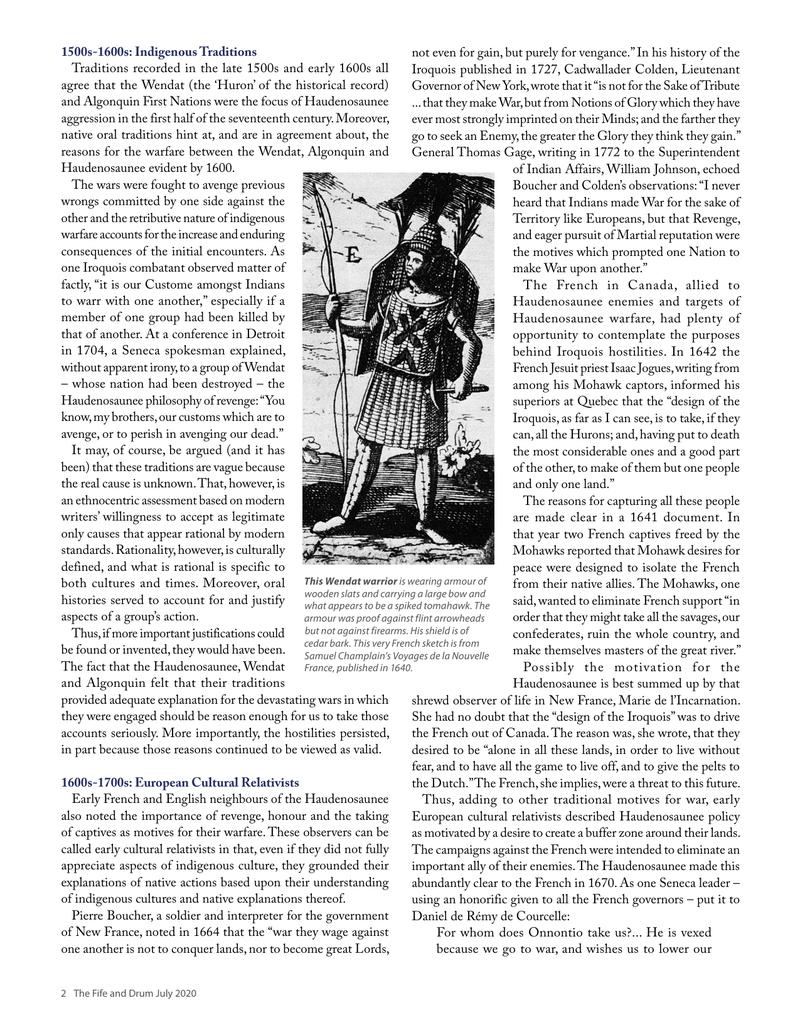
The wars were fought to avenge previous wrongs committed by one side against the other and the retributive nature of indigenous warfare accounts for the increase and enduring consequences of the initial encounters. As one Iroquois combatant observed matter of factly, “it is our Custome amongst Indians to warr with one another,” especially if a member of one group had been killed by that of another. At a conference in Detroit in 1704, a Seneca spokesman explained, without apparent irony, to a group of Wendat – whose nation had been destroyed – the Haudenosaunee philosophy of revenge: “You know, my brothers, our customs which are to avenge, or to perish in avenging our dead.”
It may, of course, be argued (and it has been) that these traditions are vague because the real cause is unknown. That, however, is an ethnocentric assessment based on modern writers’ willingness to accept as legitimate only causes that appear rational by modern standards. Rationality, however, is culturally defined, and what is rational is specific to both cultures and times. Moreover, oral histories served to account for and justify aspects of a group’s action.
Thus, if more important justifications could be found or invented, they would have been. The fact that the Haudenosaunee, Wendat and Algonquin felt that their traditions provided adequate explanation for the devastating wars in which they were engaged should be reason enough for us to take those accounts seriously. More importantly, the hostilities persisted, in part because those reasons continued to be viewed as valid.
1600s-1700s: European Cultural Relativists
Early French and English neighbours of the Haudenosaunee also noted the importance of revenge, honour and the taking of captives as motives for their warfare. These observers can be called early cultural relativists in that, even if they did not fully appreciate aspects of indigenous culture, they grounded their explanations of native actions based upon their understanding of indigenous cultures and native explanations thereof.
Pierre Boucher, a soldier and interpreter for the government of New France, noted in 1664 that the “war they wage against one another is not to conquer lands, nor to become great Lords, not even for gain, but purely for vengeance.” In his history of the Iroquois published in 1727, Cadwallader Colden, Lieutenant Governor of New York, wrote that it “is not for the Sake of Tribute … that they make War, but from Notions of Glory which they have ever most strongly imprinted on their Minds; and the farther they go to seek an Enemy, the greater the Glory they think they can.” General Thomas Gage, writing in 1772 to the Superintendent of Indian Affairs, William Johnson, echoed Boucher and Colden’s observations: “I never heard that Indians made War for the sake of Territory like Europeans; but that Revenge, and eager pursuit of Martial reputation were the motives which prompted one Nation to make War upon another.”
The French in Canada, allied to Haudenosaunee enemies and targets of Haudenosaunee warfare, had plenty of opportunity to contemplate the purposes behind Iroquois hostilities. In 1642 the French Jesuit priest Isaac Jogues, writing from among his Mohawk captors, informed his superiors at Quebec that the “design of the Iroquois, as far as I can see, is to take, if they can, all the Hurons; and, having put to death the most considerable ones and a good part of the other, to make of them but one people and only one land.”
The reasons for capturing all these people are made clear in a 1641 document. In that year two French captives freed by the Mohawks reported that Mohawk desires for peace were designed to isolate the French from their native allies. The Mohawks, one said, wanted to eliminate French support “in order that they might take all the savages, our confederates, ruin the whole country, and make themselves masters of the great river.”
Possibly the motivation for the Haudenosaunee is best summed up by that shrewd observer of life in New France, Marie de l’Incarnation. She had no doubt that the “design of the Iroquois” was to drive the French out of Canada. The reason was, she wrote, that they desired to be “alone in all these lands, in order to live without fear, and to have all the game to live off, and to give the pelts to the Dutch.” The French, she implies, were a threat to this future.
Thus, adding to other traditional motives for war, early European cultural relativists described Haudenosaunee policy as motivated by a desire to create a buffer zone around their lands. The campaigns against the French were intended to eliminate an important ally of their enemies. The Haudenosaunee made this abundantly clear to the French in 1670. As one Seneca leader – using an honorific given to all the French governors – put it to Daniel de Rémy de Courcelle:
They repeatedly expressed their concerns about the threats posed to their lands
For whom does Onnontio take us?… He is vexed because we go to war, and wishes us to lower our hatchets and leave his allies undisturbed. Who are his allies? How would he have us recognize them when he claims to take under his protection all the peoples discovered by the bearers of God’s word through all these regions; and when every day, as we learn from our people who escape from the cruelty of the stake, they make new discoveries, and enter nations which have ever been hostile to us – which, even while receiving notification of peace from Onnontio, set out from their own country to make war upon us, and to come and slay us under our very palisades?
The Haudenosaunee also complained about French encroachments on land they claimed as their own. Between 1666 and 1701 the French built nearly 30 forts and fortified posts in the St. Lawrence-Great Lakes Basin. Of these, at least seven were located around lakes Ontario and Erie – lands claimed by the Haudenosaunee and used by them for hunting.
They repeatedly expressed their concerns about the threats posed to their lands, their livelihood and security by the string of French forts. The French, they said, “build forts around us and penn us up.” They felt trapped, as if they were “in prison so long as they are standing,” and saw the forts as the first step to the eventual French usurpation of all their lands.
1800s: Cultural Relativists & Economic Determinists
In the 1800s French Canadian nationalist historians offered explanations for Haudenosaunee warfare that combined the views of the early French cultural relativists with the words of the Iroquois and other natives as recorded in French documents. However, their views came to be largely ignored. These historians had all used the Iroquois wars to serve their own nationalist ends (applauding the French and Catholic nature of New France, deploring the pursuit of commerce at the expense of farming) and their concerns did not extend to the larger academic communities of either Canada or the United States. It was Francis Parkman’s novel Beaver Wars interpretation that became accepted by most scholars as the explanation for Haudenosaunee policy and wars in general, including those against New France.
Economic Determinists: The Beaver Wars
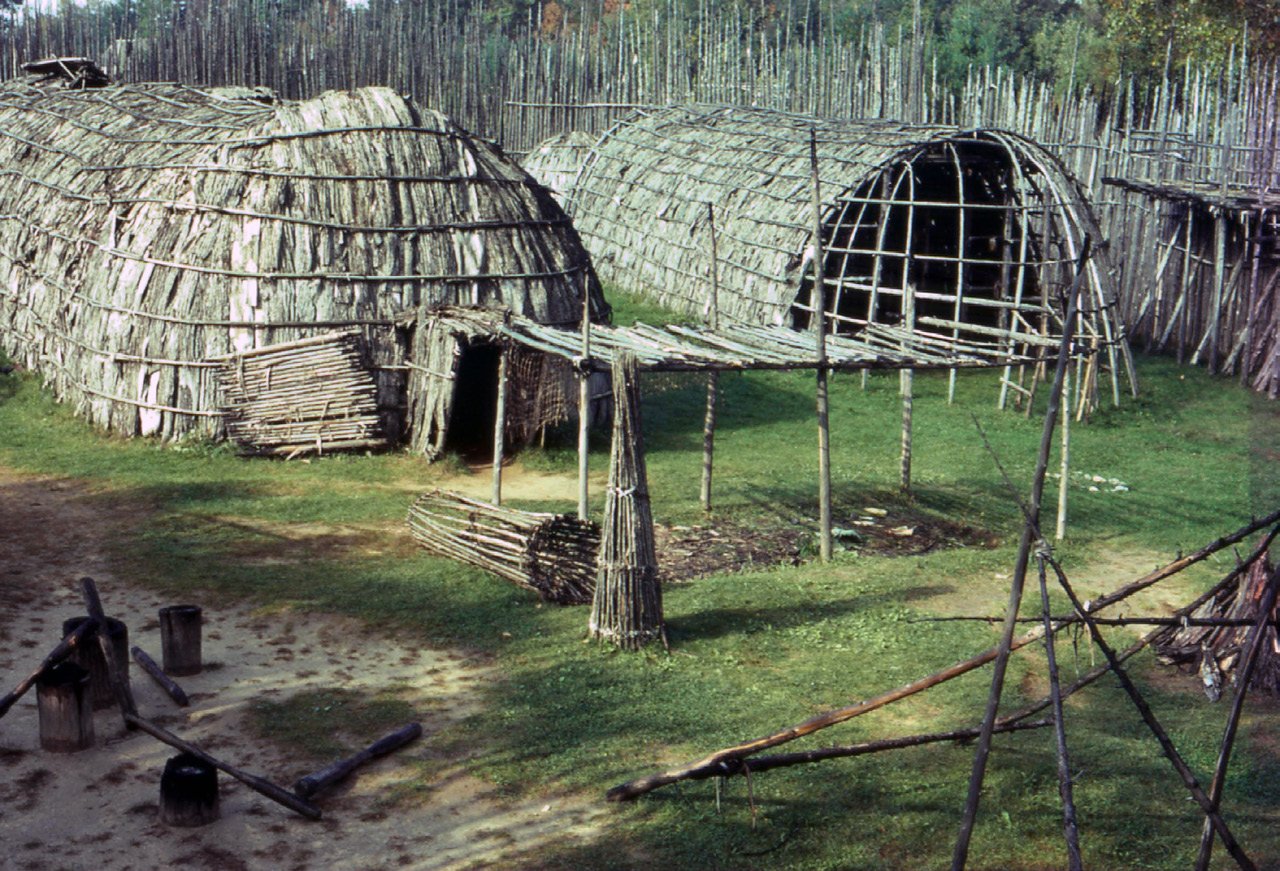
Francis Parkman was an American historian from Boston who chose as his life’s work the writing of the history of the struggle between ‘feudal’ France and ‘liberal’ England for control of north-eastern North America. According to Parkman, Haudenosaunee culture was changed by contact with Europeans and as a consequence a new culture arose that became dependent upon European material goods. The Haudenosaunee suddenly depleted their fur supply in their desire to obtain the new goods, and were then driven to raid neighbouring nations in order to plunder their furs and maintain the trade. The Iroquois waged war against New France in order to control the fur trade, which the French were trying to monopolize and which the Iroquois needed in order to gain much-required goods.
At the risk of belabouring the point, neither Parkman or his French Canadian contemporaries were interested in the history of the Haudenosaunee, their foreign policy or even their wars, in their own rights: the Haudenosaunee and their assaults were merely a means to enhance a gripping national story. That the Iroquois could be the bogeymen and cautionary examples in two national narratives is probably noteworthy in some sense, but this attention to them came at the expense of distorting their lived reality and history.
20th Century: Economic Warfare & Cultural Relativists
In 1915 American historian Charles McIlwain elaborated upon Parkman’s views, arguing that cultural change, the lack of furs and material necessity had driven the Haudenosaunee to become middlemen in the fur trade and that they fought to gain or maintain that position. In 1930 the Canadian economist Harold Innis used this explanation to account for native participation in the fur trade as part of his ground-breaking work outlining the staples theory of national economic development. In 1940 George Hunt, an American anthropologist, used it as the basis for explaining Haudenosaunee hostilities against a range of First Nations around the Great Lakes in his seminal The Wars of the Iroquois: A Study in Intertribal Trade Relations.
For these writers, all Iroquois wars were about them acting as rational twentieth-century economic beings – they were reduced, as one critic noted, to being “entrepreneurs in moccasins.” Parkman’s Whig and ethnocentric version of history (with its own form of economic and material determinism), updated according to the canons of modern scholarship by George Hunt, found fertile ground in a post-1940s Canada and United States where the Progressive and Economic schools of historical enquiry were popular.
Among such scholars of New France as Gustave Lanctot and Marcel Trudel, for whom the Iroquois wars were a major feature of the colony’s history, Hunt’s thesis was accepted without question or in only slightly modified form. William J. Eccles was the first historian of New France to fully reject the economic explanation of Haudenosaunee warfare and expansion. In its place Eccles argued, like his nineteenth-century predecessors, that Haudenosaunee warfare was part of a larger policy aimed at creating a buffer zone and maintaining political control over their neighbours. Following Eccles’ lead, Luca Codignola and Peter Moogk have downplayed the role of economic factors in explaining Haudenosaunee warfare in the colony.

Some scholars who specialize in First Nations history have been less critical of the Beaver Wars narrative. Some accept the worst of American Allen Trelease in 1960 – which pointed out serious problems with Hunt’s middleman narrative – continue to rely on that model to account for Haudenosaunee wars. Another group, namely Francis Jennings (US historian), Elisabeth Tooker (US anthropologist), Denys Delâge (Canadian sociologist), Bruce Trigger (Canadian anthropologist), Ian K. Steele (Canadian historian) and Daniel Richter (US historian) have, for the most part, rejected Hunt’s thesis.
Employing the methodology of ethnohistory, these scholars found that the middleman hypothesis was overly simplistic. Nevertheless, they persisted in the argument that economic goals were a principal driver of Haudenosaunee policy and hostilities. They also argue that the Iroquois warred to obtain furs, either for material profit or because they were dependant on European goods; and because they lacked their own, or a sufficient, supply of furs. Plus plundered furs in raids against other First Nations were then traded for needed goods. If wars took place in order to obtain furs that led to the wars of the Haudenosaunee – in short, they were Beaver Wars.
For some of these writers this was the main motive; for others, it was but one of several. But for all, economic motives lie at the root of Haudenosaunee policy and hostilities. Although these scholars recognize the enduring nature of traditional motives for indigenous warfare, rarely, if ever, are the cultural reasons for war used to account for hostilities against any one group.
Of note here is that the nationalist constructions of Haudenosaunee history have broken down – those borders have been transcended. However, Iroquois history remains firmly constrained within even narrower ideological parameters: they are represented as a poor, disadvantaged society caught up in the maw of an emerging market capitalist society, victims of an imperialist system with little agency or control over their culture and destiny. It also remains true that much of Haudenosaunee history is studied not to understand it in its own right, but to test some theory of human development.
Cultural Relativists: The Indigenous View
Recently some historians of First Nations have come to reject economic explanations for understanding Haudenosaunee policy and wars in the seventeenth century. Conrad Heidenreich and Lucien Campeau, Canadian geographer and historian respectively), scholars of the Wendat, and Dean Snow, William Engelbrecht, and William Starna, American anthropologists, students of the Haudenosaunee, have played down the role of economic warfare and have suggested that the causes of Iroquois hostility can be found in cultural practices related to war and in responses to population losses brought on by newly introduced diseases. My own work and that of Roland Viau and Jon Parmenter can also be added to this short list.
These works seek to study Haudenosaunee history for its own sake and attempt to ground explanations of Iroquois warfare in Iroquois culture. As well, they accept that Haudenosaunee culture changed more slowly, that traditional values and causes of war – such as the need for captives and revenge – were not completely, or even largely, replaced by warfare to gain access to furs; and that the main focus of Haudenosaunee policy was to preserve their political and cultural independence. These writers are clearly influenced by the contemporary debates around native rights and by the call from First Nations to have their views of the past, and their cultural values, taken into account. If there is going to be a nationalist construction of their history, it should be theirs!
The Statistics of War
What remains, then, is the question of how to transcend the interpretative impasse produced by the national and intellectual borders imposed on Haudenosaunee history. One possible way forward is to reconsider carefully the various sources used to construct this history. Such a study yields a wealth of detail and numerical data about seventeenth-century Haudenosaunee warfare. These data supports their own earliest reports of why they fought and of their overall foreign policy.
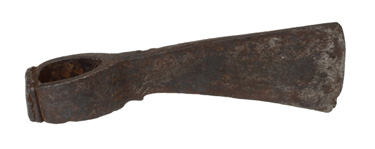
Up to 1701 the Iroquois were involved in 465 recorded hostilities. Of that number, they initiated 354 (76%), and were on the receiving end of 111. The heaviest fighting took place from 1640 to 1669 and from 1680 to 1701. During the middle decades of the century, the Iroquois were involved in 297 hostilities (an average of 99 per decade), of which they initiated 247 or 83%. In the closing twenty years of the seventeenth century, they were involved in 120 hostilities (60 per decade), of which they initiated 81 or 67%.
This last statistic is particularly interesting since it suggests that the Haudenosaunee continued to pursue their policy objectives through warfare at a time when most of the secondary literature pictures them as a defeated people, cut off from their northern hunting ranges and desperately suing the French for peace.
The Haudenosaunee attacked 51 different groups or combinations of groups – native and native – and were in turn attacked by 20 different groups or combinations of groups during the 1600s to 1701. The French and the Iroquois met in Iroquois hostility and were attacked 123 times; the Wendat were struck 73 times; the Ontario towns Iroquoian; and the Ottawa Valley Algonquins were attacked 23 times and dispersed.
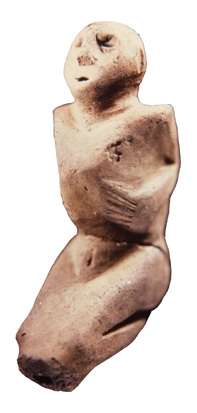
The human toll exacted on the First Nation and European populations of the Northeast by the Haudenosaunee was immense. By 1701 they had captured at least 3,810 to 4,176 people. If one adds to this total people said to have been “lost” to the Iroquois (2,277 to 2,795) but who were almost all captured rather than killed, this puts the total number of people captured at 6,087 to 6,971. During this same period they killed between 2,016 and 2,358 people. Thus the Haudenosaunee captured twice, probably three times, as many people as they killed.
The rate of captives was not, however, constant over the latter decades: 1,454 to 1,568 captives taken by 1669 and 2,384 to 2,608 taken from 1680 to 1701: a 60% increase.
This data suggests that taking captives, a traditional goal of Haudenosaunee warfare, increased in importance as a policy goal over time. The interpretation of both contemporary observers. Writing in the mid 1700s, the English naturalist John Bartram observed:
Now their numbers being very much diminished … they are upon terms very to strengthen themselves upon by alliances with their neighbours, but … [by] prisoners they take; they are almost always accepted by the relations of A warrior taken … This custom is as antient as our knowledge of them, but when their number of warriors was more than twice as many as now, the relations would more frequently refuse to adopt the prisoners but rather chuse to gratify their thirst of revenge.
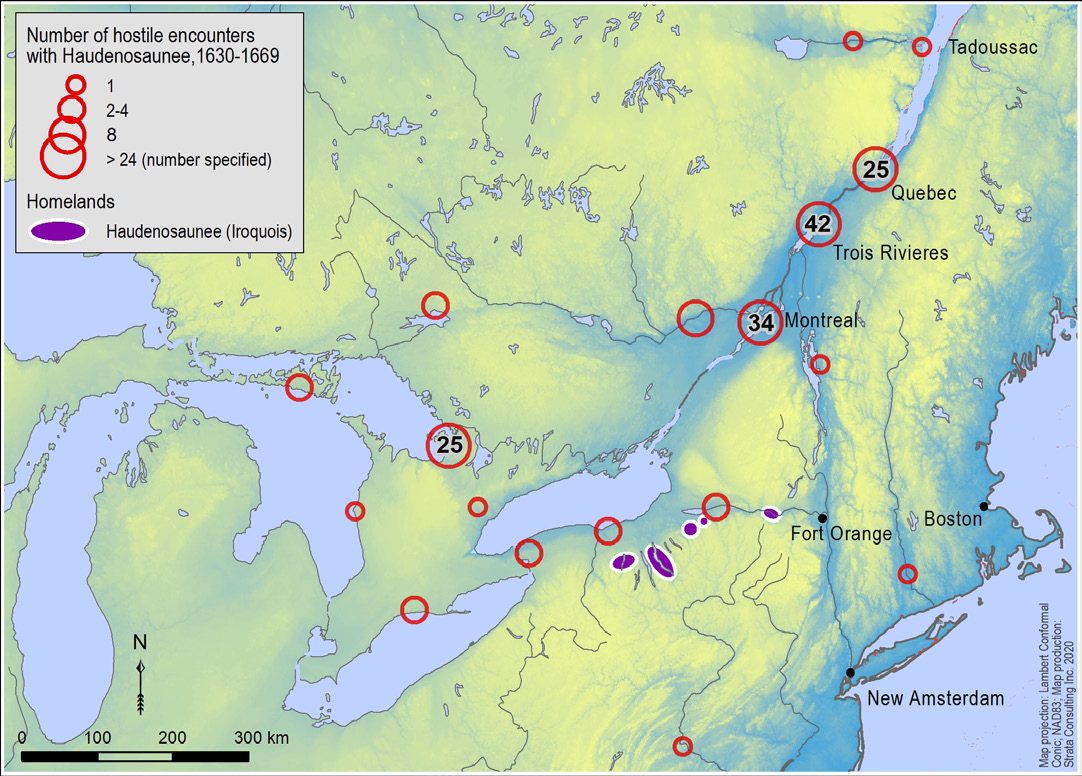
Haudenosaunee warriors ranged over a sizeable portion of north-eastern North America in pursuit of military conquest – from Virginia to Lac St. Jean and from to Green Bay to Tadoussac – but most of their hostilities were centred in the St. Lawrence Valley and in the eastern Great Lakes. This, of course, reflects the locations of the French, the Wendat and the Ottawa Valley Algonquins. This concentration of raiding also suggests, as early French writers noted, that Haudenosaunee warfare was aimed at creating a buffer zone between them and their neighbours. The reasons for doing so, despite the literature’s focus on relating hostilities to the fur trade, could be many.
The Haudenosaunee obviously needed to protect their resources for their own use. But the remarkable range of Iroquois raiding, even up to 1669, suggests that much more was involved in warring than this. Military incursions against nations months of travel from Five Nations homelands tend to reinforce the notion that warfare to revenge enemies and capture was also a factor. The widening range of enemies to the west and south, noticeable after 1680, also supports this notion. It was toward these regions that the mid-century targets of the Haudenosaunee had fled, and the shift of warfare in these directions suggests the Haudenosaunee pursued their enemies and, in the process, made new ones.
A closer look at the statistics demonstrates some interesting patterns which, in turn, reveal much about the nature and causes of Haudenosaunee warfare and policy. For example, after 1640 when New France was rarely free from either Iroquois attacks or of the fear of impending war. Between 1633 and 1697 they launched 123 raids against the French. These attacks led to the loss of 675 to 694 people from the French colony. If one includes French losses suffered in raids against groups of which the French formed a part, the figure rises to 756 to 775 French taken by the Iroquois.
This breaks down to 343 to 356 people captured and 404 to 410 people killed. Unlike the case of attacks against native enemies, the Haudenosaunee killed more French than they captured, suggesting that capture was not their primary goal. Moreover,
Original printed pages