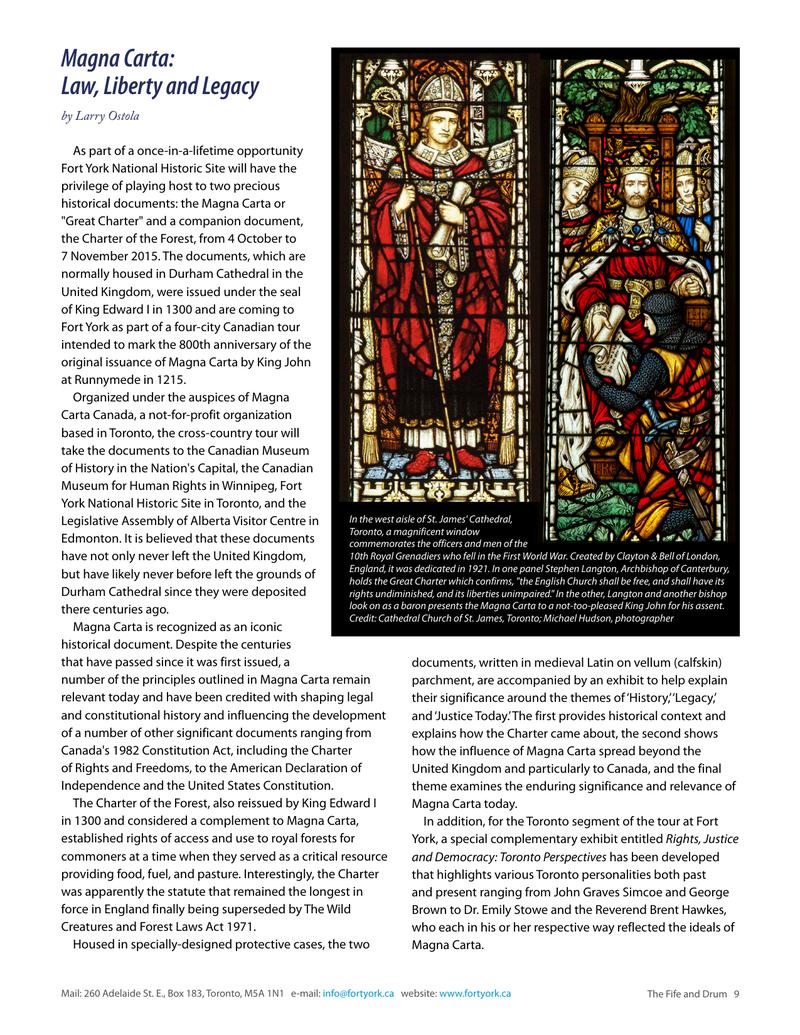
As part of a once-in-a-lifetime opportunity Fort York National Historic Site will have the privilege of playing host to two precious historical documents: the Magna Carta or “Great Charter” and a companion document, the Charter of the Forest, from 4 October to 7 November 2015. The documents, which are normally housed in Durham Cathedral in the United Kingdom, were issued under the seal of King Edward I in 1300 and are coming to Fort York as part of a four-city Canadian tour intended to mark the 800th anniversary of the original issuance of Magna Carta by King John at Runnymede in 1215.
Organized under the auspices of Magna Carta Canada, a not-for-profit organization based in Toronto, the cross-country tour will take the documents to the Canadian Museum of History in the Nation’s Capital, the Canadian Museum for Human Rights in Winnipeg, Fort York National Historic Site in Toronto, and the Legislative Assembly of Alberta Visitor Centre in Edmonton. It is believed that these documents have not only never left the United Kingdom, but have likely never before left the grounds of Durham Cathedral since they were deposited there centuries ago.
Magna Carta is recognized as an iconic historical document. Despite the centuries that have passed since it was first issued, a number of the principles outlined in Magna Carta remain relevant today and have been credited with shaping legal and constitutional history and influencing the development of a number of other significant documents ranging from Canada’s 1982 Constitution Act, including the Charter of Rights and Freedoms, to the American Declaration of Independence and the United States Constitution.
The Charter of the Forest, also reissued by King Edward I in 1300 and considered a complement to Magna Carta, established rights of access and use to royal forests for commoners at a time when they served as a critical resource providing food, fuel, and pasture. Interestingly, the Charter was apparently the statute that remained the longest in force in England finally being superseded by The Wild Creatures and Forest Laws Act 1971.
Housed in specially-designed protective cases, the two documents, written in medieval Latin on vellum (calfskin) parchment, are accompanied by an exhibit to help explain their significance around the themes of ‘History,’ ‘Legacy,’ and ‘Justice Today.’ The first provides historical context and explains how the Charter came about, the second shows how the influence of Magna Carta spread beyond the United Kingdom and particularly to Canada, and the final theme examines the enduring significance and relevance of Magna Carta today.
In addition, for the Toronto segment of the tour at Fort York, a special complementary exhibit entitled Rights, Justice and Democracy: Toronto Perspectives has been developed that highlights various Toronto personalities both past and present ranging from John Graves Simcoe and George Brown to Dr. Emily Stowe and the Reverend Brent Hawkes, who each in his or her respective way reflected the ideals of Magna Carta.
The Fort York exhibit will also feature a speakers series with guests such as historian Dr. Carolyn Harris of the University of Toronto, Sukyana Pillay, executive director of the Canadian Civil Liberties Association, ‘Jane Doe’ who won a landmark legal decision related to equality rights and security of the person, and others who through their work or experiences reflect different facets of the still-evolving meaning and relevance of Magna Carta.

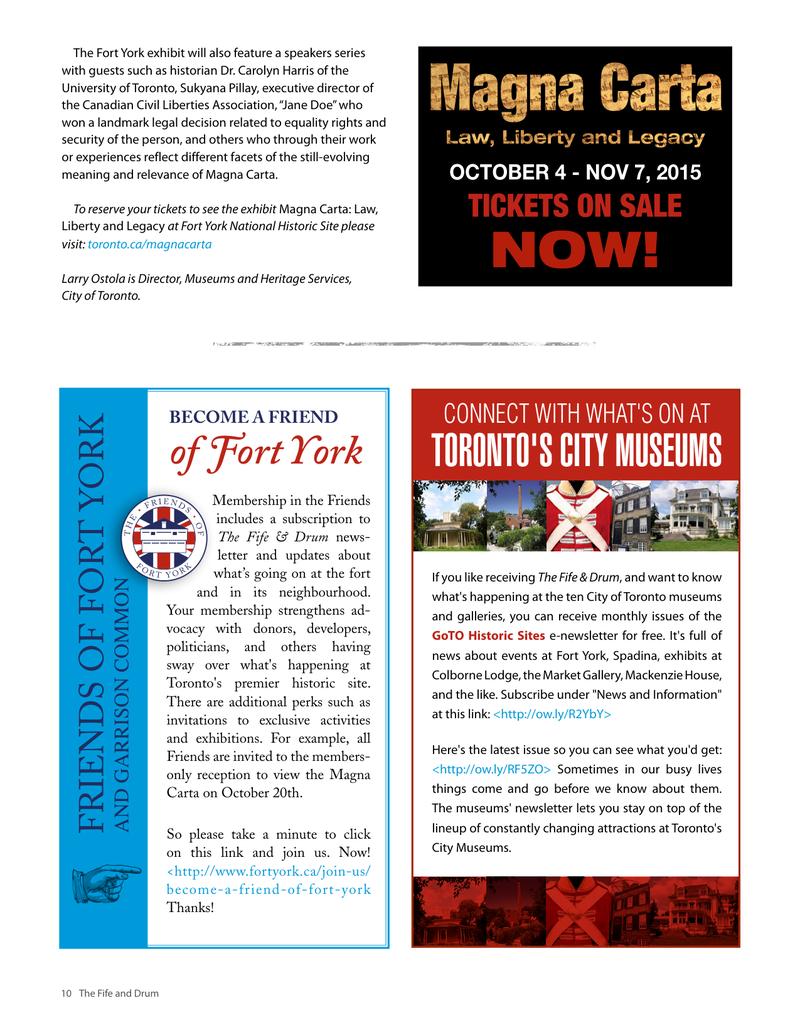
To reserve your tickets to see the exhibit Magna Carta: Law, Liberty and Legacy at Fort York National Historic Site please visit: toronto.ca/magnacarta
Original printed pages