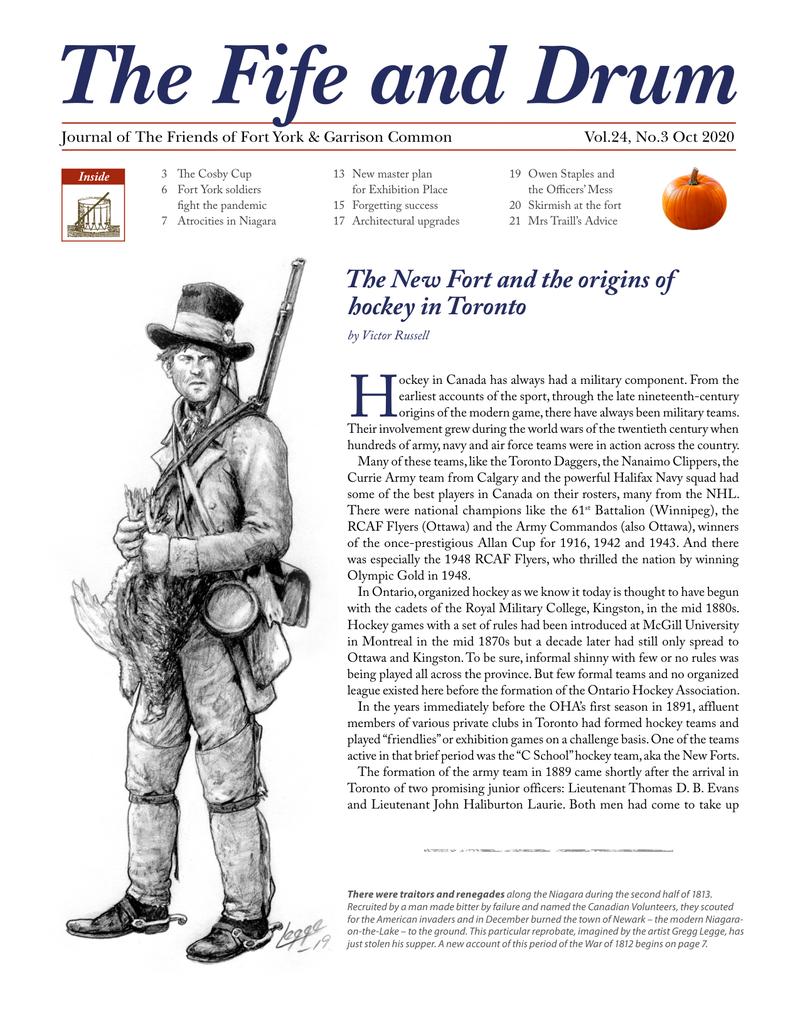
Hockey in Canada has always had a military component. From the earliest accounts of the sport, through the late nineteenth-century origins of the modern game, there have always been military teams. Their involvement grew during the world wars of the twentieth century when hundreds of army, navy and air force teams were in action across the country.
Many of these teams, like the Toronto Daggers, the Nanaimo Clippers, the Currie Army team from Calgary and the powerful Halifax Navy squad had some of the best players in Canada on their rosters, many from the NHL. There were national champions like the 61st Battalion (Winnipeg), the RCAF Flyers (Ottawa) and the Army Commandos (also Ottawa), winners of the once-prestigious Allan Cup for 1916, 1942 and 1943. And there was especially the 1948 RCAF Flyers, who thrilled the nation by winning Olympic Gold in 1948.
In Ontario, organized hockey as we know it today is thought to have begun with the cadets of the Royal Military College, Kingston, in the mid 1880s. Hockey games with a set of rules had been introduced at McGill University in Montreal in the mid 1870s but a decade later had still only spread to Ottawa and Kingston. To be sure, informal shinny with few or no rules was being played all across the province. But few formal teams and no organized league existed here before the formation of the Ontario Hockey Association.
In the years immediately before the OHA’s first season in 1891, affluent members of various private clubs in Toronto had formed hockey teams and played “friendlies” or exhibition games on a challenge basis. One of the teams active in that brief period was the “C School” hockey team, aka the New Forts.
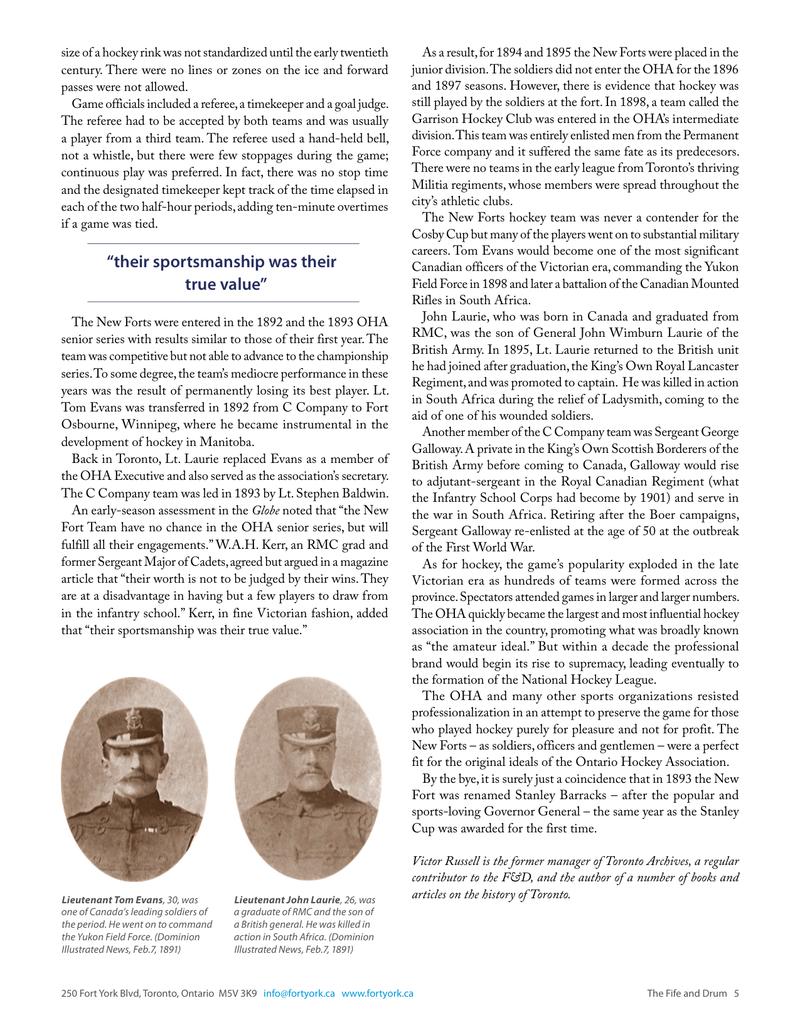
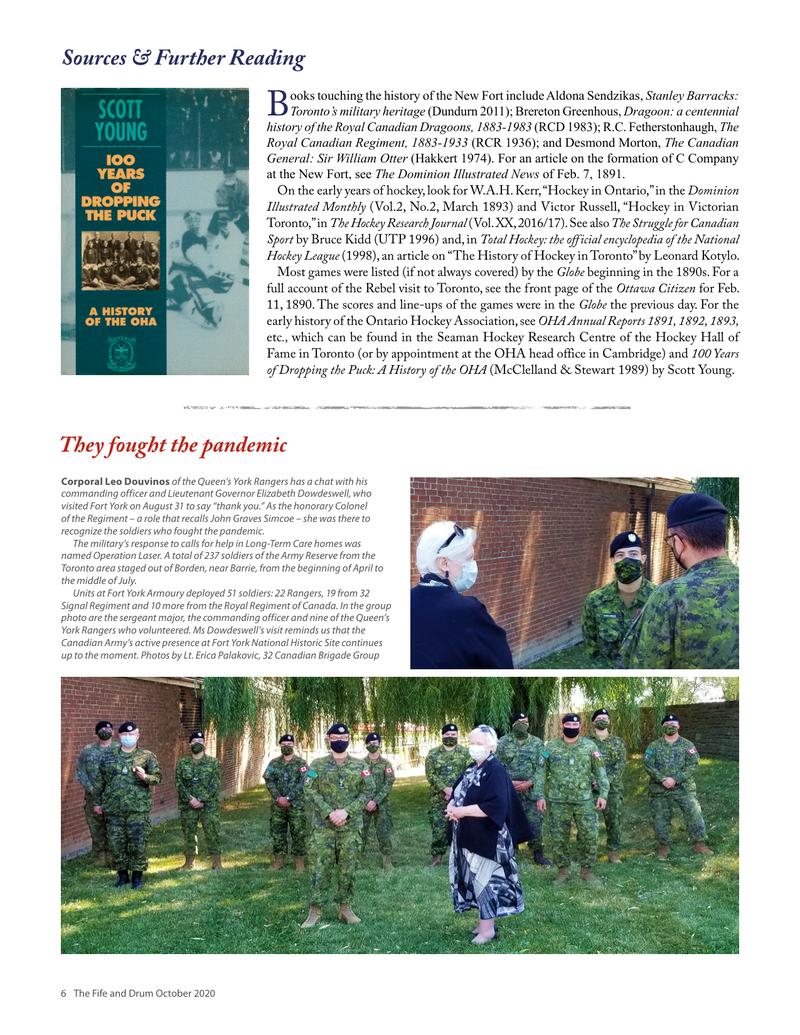
The formation of the army team in 1889 came shortly after the arrival in Toronto of two promising junior officers: Lieutenant Thomas D. B. Evans and Lieutenant John Haliburton Laurie. Both men had come to take up appointments in the Infantry School Corps, whose C Company was stationed at Toronto under the command of Lieutenant-Colonel William Dillon Otter. Evans was from Ottawa and Laurie was a graduate of RMC in Kingston, so it is likely that both men had been involved in hockey before.
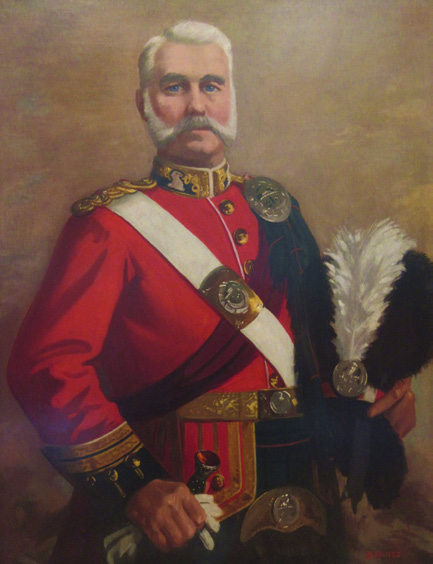
Lt.-Col. Otter encouraged a range of sports at the fort. A committed athlete, Otter had been a champion rower as a youth; he was the founding president and a former star of the Toronto Lacrosse Club; and he had served as an executive of the Toronto Gymnasium Association. The barracks had its own gymnasium.
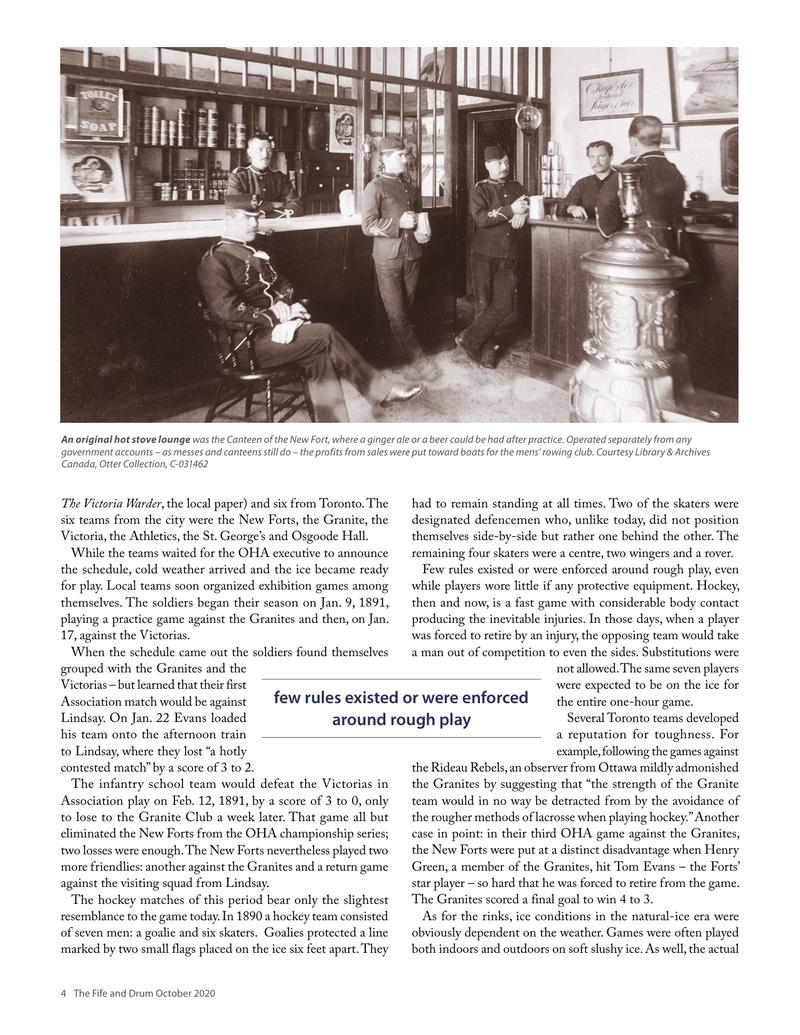
In the case of hockey, Lt. Evans took the lead and acted as the team’s captain, arranging a number of “friendly matches” with other recently formed teams in the city. Evans and Laurie also oversaw the construction of a rink on the grounds of the New Fort for the team’s practices and exhibition games.
The move to formalize hockey competition in the province gained momentum in February 1890 when the Rideau Hall Rebels Hockey Club of Ottawa came to Toronto. Rebel players included several MPs, one well-known athlete and the two sons of the Governor General himself, Lord Stanley of Preston. Arriving in the Governor General’s private railway car, the Rideau Rebels were received and entertained by Toronto society with all the deference, pomp, and formality thought to be due a Vice Regal party.
While in the city the Rebels played two games against Toronto teams that attracted a great deal of attention. As one observer noted, the rinks were “crowded with the elite of Toronto society,” including no doubt our lieutenants Evans and Laurie.
Following the Vice Regal tour of the province, one of Lord Stanley’s sons, the Hon. Arthur Stanley, concluded that what was needed was a provincial organization to govern the sport and to establish a framework to produce a provincial champion. Lacrosse and football associations were already in place. Subsequently, Arthur convinced his father to be the Patron and then proposed a meeting to discuss formalizing the 1891 season.
The meeting that Stanley proposed was held on Nov. 27, 1890, at the Queen’s Hotel in Toronto. It led to the formation of OHA. More than a dozen eminent men from various locales attended, with Arthur Stanley representing Ottawa. The largest delegation was from Toronto and included seven local athletes.
a provincial organization to govern the sport
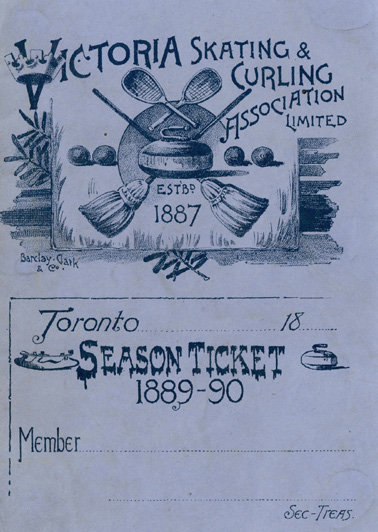
There was James Garvin, barrister, all-star lacrosse player and member of the Granite Club; Henry Green, also from the Toronto Lacrosse and the Granite Club; John Thompson, a law student representing Osgoode Hall; William Booth from the Old Athletic Lacrosse Club and the Victoria Club; Frank Jackson, from the St. George’s Club; Charles Hamilton from the Victoria Club; and Lt. Evans for the New Forts. During the meeting, Evans agreed to act on the first Executive Committee of the OHA.
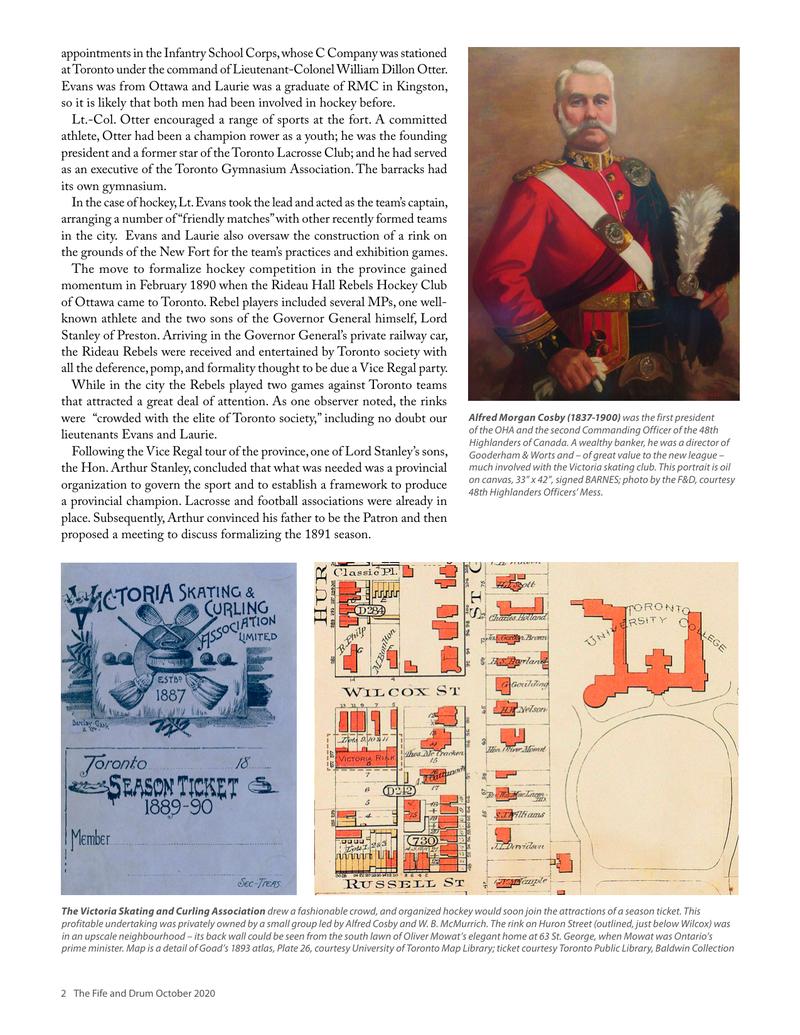
The first order of business was the naming of a president. The group unanimously agreed to appoint Alfred Morgan Cosby. An investment banker and member of the city’s business elite – he had married Clara Worts, of Gooderham & Worts – Cosby would become Commanding Officer of the 48th Highlanders in 1898. He and Clara had hosted the Rideau Rebels (who were clearly anything but) at his stately home on College Street.
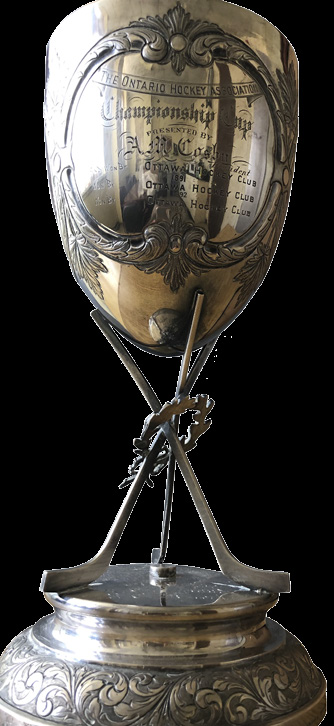
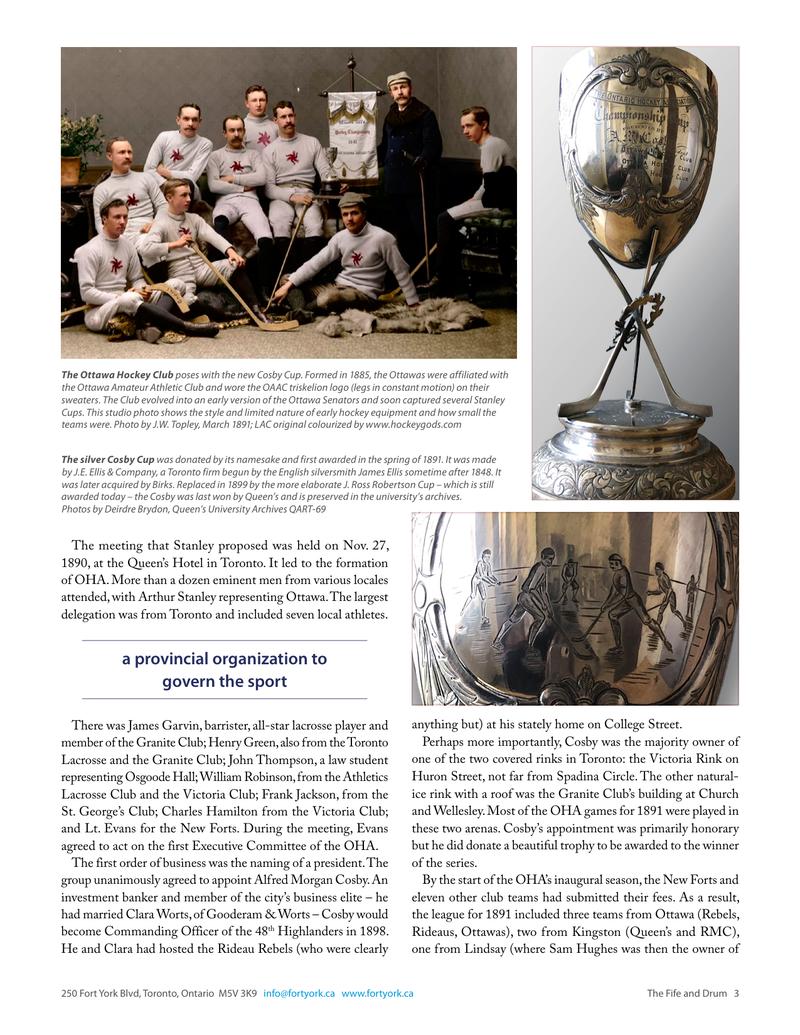
Perhaps more importantly, Cosby was the majority owner of one of the two covered rinks in Toronto: the Victoria Rink on Huron Street, run by the Athenaeum Circle. The other natural-ice rink with a roof was the Granite Club’s building at Church and Wellesley. Most of the OHA games for 1891 were played in these two arenas. Cosby’s appointment was primarily honorary but he did donate a beautiful trophy to be awarded to the winner of the series.
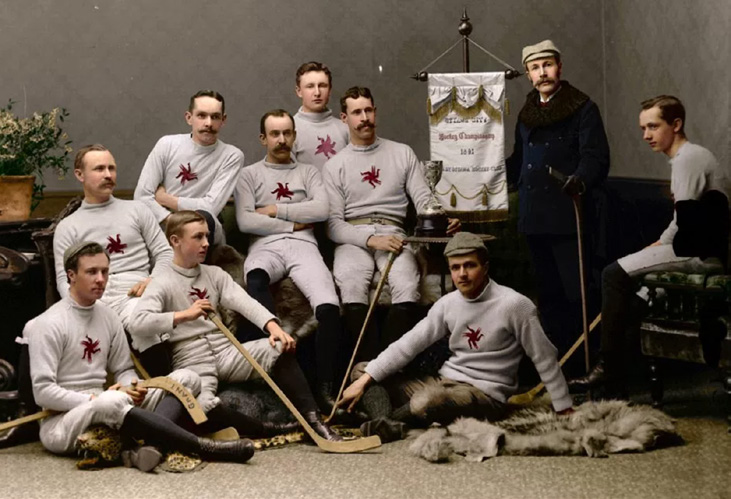
By the start of the OHA’s inaugural season, the New Forts and eleven other club teams had submitted their fees. As a result, the league for 1891 included three teams from Ottawa (Rebels, Rideaus, Ottawas), two from Kingston (Queen’s and RMC), one from Lindsay (where Sam Hughes was then the owner of The Victoria Warder, the local paper) and six from Toronto. The six were from the city: the New Forts, the Granites from Victoria, the Athletics, the St. George’s and Osgoode Hall.
While the teams waited for the OHA’s schedule to announce the schedule, cold weather arrived and the ice became ready for play. Local teams soon organized exhibition games among themselves. The soldiers began their season on Jan. 9, 1891, playing a practice game against the Granites and then, on Jan. 17, against the Victorias.
When the schedule came out the soldiers found themselves grouped with the Granites and the Victorias – but feared that their first Association match would be against Lindsay. On Jan. 22 Evans loaded his team onto the afternoon train for Lindsay, where they lost “a hotly contested match” by a score of 3 to 2.
The infantry school team would defeat the Victorias in Association play on Feb. 12, 1891, by a score of 3 to 0, only to lose to the Granite Club a week later. That game all but eliminated the New Forts from the OHA championship series; two losses were enough. The New Forts nevertheless played two more friendlies: another against the Granites and a return game against the visiting squad from Lindsay.
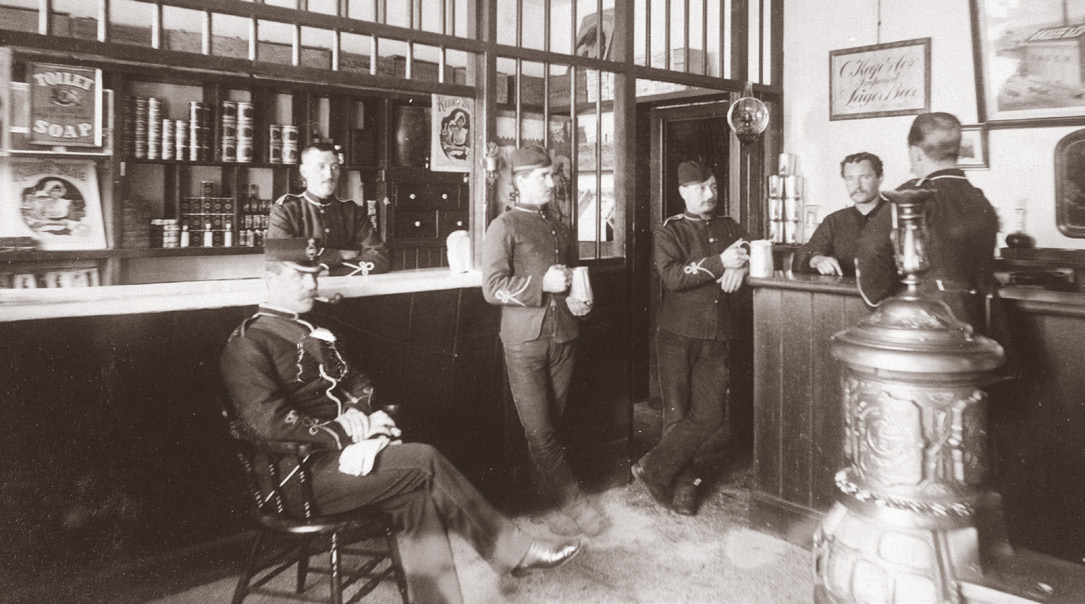
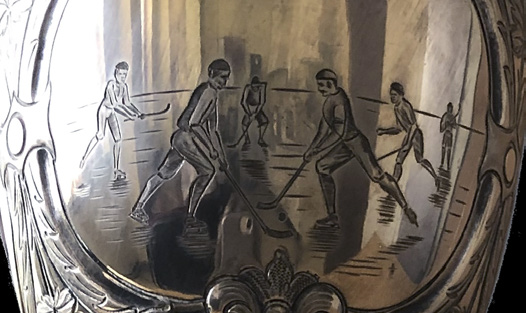
The hockey matches of this period bear only the slightest resemblance to the game today. In 1890 a hockey team consisted of seven men: a goalie and six skaters. Goalies protected a line marked by two small flags placed on the ice six feet apart. They had to remain standing at all times. Two of the skaters were designated as defencemen who, unlike today, did not position themselves side-by-side but rather one behind the other. The remaining four skaters were a point, two wingers and a rover.
Few rules existed or were enforced around rough play, even while players wore little if any protective equipment. Hockey, then as now, is a fast game with considerable body contact producing the inevitable injuries. In those days, when a player was forced to retire by an injury, the opposing team would take a man out of competition to even the sides. Substitutions were not allowed. The same seven players were expected to be on the ice for the entire one-hour game.
few rules existed or were enforced around rough play
Several Toronto teams developed a reputation for toughness. For example, following the games against the Rideau Rebels, an observer from Ottawa mildly admonished the Granites by suggesting that “the strength of the Granite team would in no way be detracted from by the avoidance of the rougher methods of lacrosse when playing hockey.” Another case in point is their third OHA game against the Granites, the New Forts were put at a distinct disadvantage when Henry Green, a member of the Granites, hit Tom Evans – the Forts’ star player – so hard that he was forced to retire from the game. The Granites scored a final goal to win 4 to 3.
As for the rinks, ice conditions in the natural-ice era were obviously dependent on the weather. Games were often played both indoors and outdoors on soft slushy ice. As well, the actual size of a hockey rink was not standardized until the early twentieth century. There were no blue lines for offside and forward passes were not allowed.
Game officials included a timekeeper and a goal judge. The referee had to be accepted by both teams and was usually a player from a third team. The referee used a hand-held bell, not a whistle, but there were few stoppages during the game; continuous play was preferred. In fact, there was no stop time for the designated number of minutes each time elapsed in each of the two half-hour periods, adding ten-minute overtimes if a game was tied.
“their sportsmanship was their true value”
The New Forts were entered in the 1892 and the 1893 OHA senior series with results similar to those of their first year. The team was competitive but not able to win the championship series. To some degree, the team’s mediocre performance in these years was the result of permanently losing its best player. Lt. Tom Evans was transferred in 1892 from “C” Company to Osbourne, Winnipeg, where he became instrumental in the development of hockey in Manitoba.
Back in Toronto, Lt. Laurie replaced Evans as a member of the OHA Executive and also served as the association’s secretary. The C Company team was led in 1893 by Lt. Stephen Baldwin.
An early-season assessment in the Globe noted that “the New Fort Team have no chance in the OHA’s senior series, [but] fulfill all their engagements.” W.A.H. Kerr, an RMC grad and former Sergeant Major of Cadets, agreed but argued in a magazine article that “their worth is not to be judged by their wins. They are at a disadvantage in having but a few players to draw from in the infantry school.” Kerr, in fine Victorian fashion, added that “their sportsmanship was their true value.”
As a result, for 1894 and 1895 the New Forts were placed in the junior division. The soldiers did not enter the OHA for the 1896 and 1897 seasons. However, there is evidence that hockey was still played by them. In Oct. In 1898, a team called the Garrison Hockey Club was entered in the OHA’s intermediate division. This consisted entirely of enlisted men from the Permanent Force company and it suffered the same fate as its predecessors. There were no teams in the early league from Toronto’s thriving Militia regiments, whose members were spread throughout the city’s athletic clubs.
The New Forts hockey team was never a contender for the Cosby Cup but many of the players went on to substantial military careers. Tom Evans would become one of the most significant Canadian officers of the Victorian era, commanding the Yukon Field Force in 1898 and later a battalion of the Canadian Mounted Rifles during the Boer War in South Africa.
John Laurie, who was born in Canada and graduated from RMC, was the son of General John Wimburn Laurie of the British Army. In 1895, Lt. Laurie returned to the British unit he had joined after graduation, the King’s Own Royal Lancaster Regiment, and was promoted to captain. He was killed in action in South Africa during the relief of Ladysmith, coming to the aid of one of his wounded soldiers.
Another member of the C Company team was Sergeant George Galloway. A private in the King’s Own Scottish Borderers of the British Army before coming to Canada, Galloway would rise to adjutant-sergeant in the Royal Canadian Regiment (what the Infantry School Corps had become by 1901) and serve in the war in South Africa. Retiring after the Boer campaigns, Sergeant Galloway re-enlisted at the age of 50 at the outbreak of the First World War.
As for hockey, the game’s popularity exploded in the late Victorian era as hundreds of teams were formed across the province. Spectators attended games in larger and larger numbers. The OHA quickly became the largest and most influential hockey association in the country, promoting what was broadly known as “the amateur ideal.” But within a decade the professional brand would begin its rise to supremacy, leading eventually to the formation of the National Hockey League.
The OHA and many other sports organizations resisted professionalization in an attempt to preserve the game for those who played hockey purely for pleasure and not for profit. The New Forts – as soldiers, officers and gentlemen – were a perfect fit for the original ideals of the Ontario Hockey Association.
By the time it is surely no coincidence that in 1893 the New Fort was renamed Stanley Barracks – after the popular and sports-loving Governor General – the same year as the Stanley Cup was awarded for the first time.
Sources & Further Reading
Books touching the history of the New Fort include Aldona Sendzikas, Stanley Barracks: Toronto’s military heritage (Dundurn 2011); Brereton Greenhous, Dragoon: a centennial history of the Royal Canadian Dragoons, 1883-1983 (RCD 1983); R.C. Fetherstonhaugh, The Royal Canadian Regiment, 1883-1933 (RCR 1936); and Desmond Morton, The Canadian General: Sir William Otter (Hakkert 1974). For an article on the formation of C Company at the New Fort, see The Dominion Illustrated News of Feb. 7, 1891.
On the early years of hockey, look for W.A.H. Kerr, “Hockey in Ontario,” in the Dominion Illustrated Monthly (Vol.2, No.2, March 1893) and Victor Russell, “Hockey in Victorian Toronto,” in The Hockey Research Journal (Vol.XX, 2016/17). See also The Struggle for Canadian Sport by Bruce Kidd (UTP 1996) or Total Hockey – the official encyclopedia of the National Hockey League (1998), an article on “The History of Hockey in Toronto by Leonard Kotylo. Most games were listed (if not always covered) by the Globe beginning in the 1890s. For a full account of the Rebel visit to Toronto, see the front page of the Ottawa Citizen for Feb. 11, 1890. The scores and line-ups of the games were in the Globe the previous day. For the early history of the Ontario Hockey Association, see OHA Annual Reports 1891, 1892, 1893, etc., which can be found in the Seaman Hockey Research Centre of the Hockey Hall of Fame in Toronto (or by appointment at the OHA head office in Cambridge) and 100 Years of Dropping the Puck: A History of the OHA (McClelland & Stewart 1989) by Scott Young.
Original printed pages